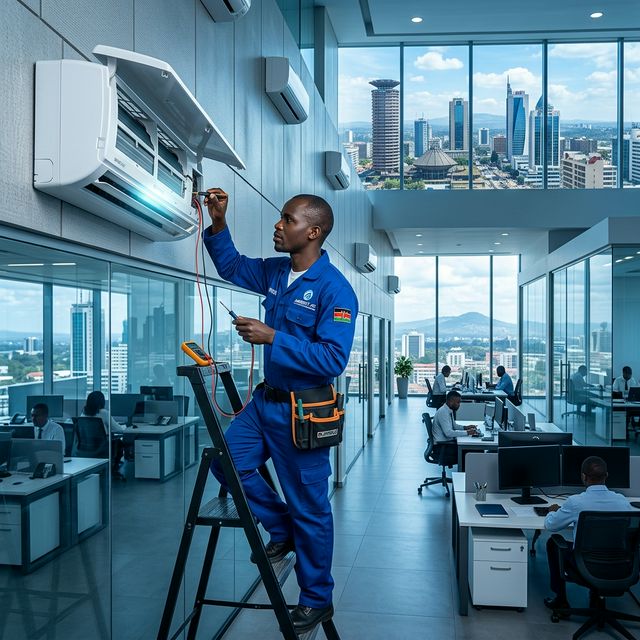
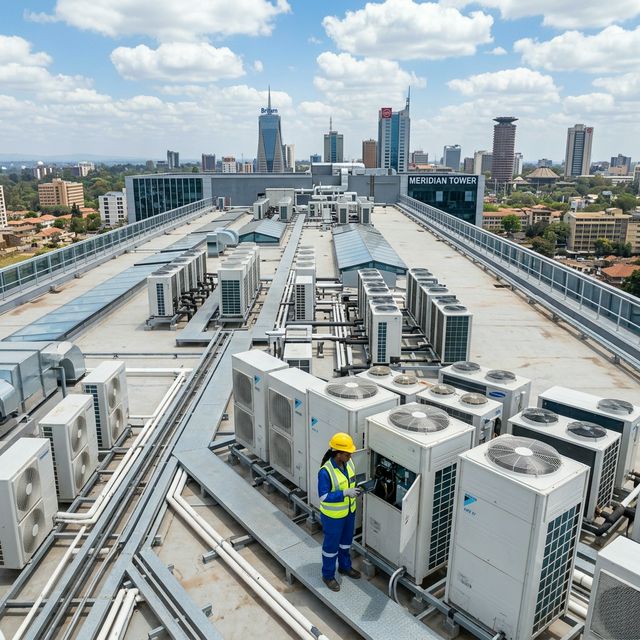
By Spinel Dynamics Group | Kenya’s Leading Air Conditioning Contractors & HVAC Engineers
Need air conditioning installation and repair in Kenya? Get expert AC installation, servicing & 24/7 repair from Spinel Dynamics Group. Free site visit & quote.
Why Professional AC Installation and Repair Matters in Kenya
Kenya is changing fast. Rising daytime temperatures, longer hot seasons, denser buildings, modern glass-clad offices and growing customer expectations have made air conditioning an essential service rather than a luxury. From open-plan offices in Westlands to busy restaurants in Mombasa, from hospital wards in Kisumu to bedrooms in Karen, air conditioning installation and repair in Kenya has become one of the most in-demand technical services in the country.
But here is the uncomfortable truth: most AC problems in Kenya are not equipment failures. They are installation failures. A premium Daikin or Carrier unit installed poorly will fail faster, consume more electricity and cool less effectively than a mid-range unit installed properly. Conversely, even a budget AC will perform reliably for years when sized, installed and commissioned by a competent team.
At Spinel Dynamics Group, we have spent over a decade installing, maintaining and repairing air conditioning systems across Kenya and East Africa. We have fitted split units in single-bedroom apartments and commissioned 600-ton VRF systems for commercial towers. This guide brings together everything we have learned — types of air conditioning, sizing, prices, installation steps, common faults, repair costs and how to choose the right AC contractor in Kenya.
What Is Air Conditioning?
Air conditioning is the controlled cooling, dehumidification and circulation of indoor air. A modern air conditioner does not just blow cold air. A properly designed AC system controls four things at once: temperature (how warm or cool the air is), humidity (how much moisture is in the air), air movement (how the cool air is distributed), and air quality (filtration of dust, allergens and odours).
In Kenya, climate varies dramatically — from the hot, humid coast in Mombasa and Diani, to the warm savannah of Nairobi and Machakos, to the cool highlands of Eldoret and Limuru. Each climate zone benefits from a different AC strategy, which is why no two installations should ever be copy-paste.
How an Air Conditioner Works
Every air conditioner — whether a tiny window unit or a giant chiller — uses the same basic refrigeration cycle. A compressor pressurises a refrigerant gas, raising its temperature. The hot, high-pressure gas flows through a condenser coil where outdoor air carries the heat away, and the refrigerant condenses to a liquid. The liquid passes through an expansion valve, dropping in pressure and becoming very cold. It then flows through an evaporator coil indoors, where indoor air blows across it. The cold coil absorbs heat from the room, cooling the air. The refrigerant evaporates back to a gas and returns to the compressor, repeating the cycle.
Understanding this matters because every common AC fault — poor cooling, ice on the coils, water leaks, high power bills — traces back to one of these components.
Types of Air Conditioning Systems Available in Kenya
Choosing the right system type is the most important decision in any AC project. Here are the systems we install across Kenya.
1. Wall-Mounted Split Air Conditioners
The most popular AC type in Kenya. Wall-mounted splits consist of two parts — a slim indoor unit mounted high on a wall, and an outdoor condenser unit installed outside the building. Refrigerant copper pipes and electrical cables connect them.
Wall splits are ideal for bedrooms, living rooms, small offices, shops, classrooms and clinics. Capacities range from 9,000 BTU/hr (suitable for a small bedroom) up to 36,000 BTU/hr (large living rooms or open-plan offices). Modern inverter-driven splits can save up to 60% on electricity compared to older fixed-speed units.
2. Floor-Standing Air Conditioners
Floor-standing splits are tall cabinet-style indoor units, typically 1.8 to 2 metres high, that sit on the floor against a wall. They have higher cooling capacity than wall units (typically 24,000 to 60,000 BTU/hr) and are popular in large living rooms, conference rooms, hotel lobbies, restaurants, showrooms and places of worship.
They cool large spaces quickly and look professional, but require dedicated floor space, which can be a limitation.
3. Cassette Air Conditioners
Cassette units sit flush in a suspended ceiling, with only a square decorative grille visible. Air is discharged through 4 louvers in 4 directions, providing even cooling across the room.
Cassettes are the go-to choice for offices, retail spaces, restaurants, hotel rooms, banking halls and any space with a suspended ceiling where wall space is limited or aesthetics matter. Capacities range from 18,000 BTU/hr to 60,000 BTU/hr per cassette.
4. Ducted Air Conditioning
Ducted AC systems hide the indoor unit completely in a ceiling void or service room, and distribute cool air through concealed ductwork to multiple rooms via discreet ceiling diffusers. Only the diffusers are visible — the equipment is invisible.
Ducted systems are popular in high-end residential homes, luxury hotel suites, corporate boardrooms, and any project where a clean, minimal interior aesthetic is required. They are more expensive to install than splits but deliver superior comfort and unmatched visual finish.
5. VRF / VRV Centralized Air Conditioning Systems
Variable Refrigerant Flow (VRF), known as VRV in Daikin terminology, is the gold standard for multi-room commercial air conditioning. A single outdoor unit can serve dozens of indoor units — wall, cassette, ducted and floor-standing — across multiple floors of a building.
VRF systems are typically used in office buildings, hotels, hospitals, schools, shopping malls and large residences. The key benefits are precise zone-by-zone temperature control, very high energy efficiency, smaller piping and wiring than traditional systems, the ability to heat one room while cooling another (heat recovery systems), and centralised monitoring through building management systems.
We install and work with Daikin VRV, Carrier Toshiba VRF, LG MultiV, Samsung DVM and Midea V8 VRF systems. A typical commercial VRF project in Nairobi ranges from 20 to 200 tons of cooling capacity.
6. Chilled Water Air Conditioning (Chiller Systems)
For very large buildings — shopping malls, hospitals, airports, factories, high-rise office towers — chilled water systems are the most practical solution. A central chiller (air-cooled or water-cooled) produces chilled water at 6–8°C, which is then pumped through insulated pipes to Air Handling Units (AHUs) and Fan Coil Units (FCUs) distributed throughout the building.
Chiller systems handle cooling loads from 50 tons up to thousands of tons. We design and install chilled water systems for institutional and large commercial projects across Kenya, working with Carrier, Trane, York, Daikin Applied and Climaveneta chiller technology.
7. Portable and Window Air Conditioners
Portable AC units roll on castors and exhaust hot air through a flexible hose run to a window or wall opening. They are useful for temporary cooling, server rooms, events and rental properties. Window units are wall- or window-mounted single-piece air conditioners, less common now but still used in some budget applications.
8. Specialised AC Systems
We also install precision cooling systems for server rooms and data centres (which need tight temperature and humidity control), rooftop packaged units for warehouses and industrial buildings, and marine and vehicle AC for specialist applications.
Air Conditioning Brands We Install in Kenya
Spinel Dynamics Group supplies and installs a wide range of the world’s leading air conditioning brands. We supply genuine, warranty-backed equipment.
Daikin (Japan) — the global leader in inverter air conditioning and VRV technology. Our flagship premium choice for any project where reliability and efficiency matter.
Carrier (USA) — the inventor of modern air conditioning. Strong in commercial chillers, rooftop units and VRF systems.
Samsung (South Korea) — innovative inverter splits and DVM VRF systems with strong WiFi connectivity and smart features.
LG (South Korea) — energy-efficient inverter splits, cassettes and MultiV VRF systems with industry-leading warranties.
Toshiba (Japan) — premium splits and VRF systems with quiet operation and high build quality.
Midea (China) — excellent value-for-money air conditioning across all segments. We install large volumes of Midea splits across Kenya.
Panasonic (Japan) — reliable splits with strong Nanoe air purification technology.
Gree (China) — affordable, robust splits widely used in Kenya’s residential market.
Hisense, TCL, Beko, Westpoint — budget brands suitable for cost-sensitive residential projects.
We help you choose the right brand based on your budget, performance requirements, warranty needs and after-sales support priorities.
How to Size an Air Conditioner Correctly
The single most common mistake we see in Kenya is incorrect AC sizing. An undersized AC runs constantly without ever cooling the room. An oversized AC cools quickly but cycles on and off too frequently, fails to dehumidify the air, wastes electricity and wears out the compressor prematurely.
The Rough Rule of Thumb
As a starting point, expect to need approximately 600 BTU/hr per square metre of typical indoor space in Nairobi conditions. This rough estimate gives:
- 12 m² bedroom → 9,000 BTU/hr (1 ton)
- 20 m² living room → 12,000 BTU/hr (1 ton)
- 30 m² office → 18,000 BTU/hr (1.5 tons)
- 50 m² shop → 24,000 BTU/hr (2 tons)
- 80 m² restaurant → 36,000 BTU/hr (3 tons)
The Proper Method: Heat Load Calculation
For any project beyond a single bedroom, rules of thumb are not enough. Our engineers perform a proper heat load calculation considering: floor area and ceiling height, wall and roof construction (heat conduction), window area, orientation and shading (solar gain), number of people occupying the space, lights, computers, kitchen equipment and other heat sources, fresh air ventilation requirements, location (Mombasa vs Nairobi vs Eldoret), and time of peak load.
The output is a precise BTU/hr requirement that ensures the AC will cool effectively, run efficiently and last its full design life.
Air Conditioning Prices in Kenya (2026)
AC pricing depends on brand, capacity, type, installation complexity and accessories like extended piping, additional electrical work, or builders’ work for ducting. Below are realistic 2026 price ranges from Spinel Dynamics Group, in Kenya Shillings (KSh) and excluding VAT. Prices are for supply + standard installation.
| AC Type & Capacity | Suitable For | Indicative Price Range (KSh) |
|---|---|---|
| 9,000 BTU wall split (budget) | Small bedroom | 38,000 – 60,000 |
| 9,000 BTU wall split (premium) | Small bedroom | 65,000 – 110,000 |
| 12,000 BTU wall split (budget) | Bedroom/small living room | 45,000 – 75,000 |
| 12,000 BTU wall split (premium inverter) | Bedroom/small office | 85,000 – 140,000 |
| 18,000 BTU wall split (inverter) | Living room/medium office | 95,000 – 170,000 |
| 24,000 BTU wall split (inverter) | Large living room/office | 130,000 – 230,000 |
| 36,000 BTU wall/floor split | Large room/restaurant | 200,000 – 350,000 |
| Cassette unit 24,000–60,000 BTU | Office/restaurant/retail | 220,000 – 550,000 |
| Floor-standing 48,000–60,000 BTU | Hotel lobby/conference room | 300,000 – 650,000 |
| Ducted indoor unit (per zone) | Premium homes/offices | 280,000 – 700,000 |
| VRF system (small, 5–8 indoor units) | Small office/villa | 1,800,000 – 4,500,000 |
| VRF system (medium, 12–20 indoor units) | Mid-size office building | 4,500,000 – 12,000,000 |
| VRF system (large, 30+ indoor units) | Commercial building | 12,000,000 – 40,000,000+ |
| Chilled water system | Large commercial/institutional | Project-specific |
For a precise quotation for your specific space, request a free site visit.
What Is Included in Our Standard Installation
Our quoted installation price includes mounting brackets for indoor and outdoor units, up to 3 metres of insulated refrigerant copper piping, electrical cable between the two units, condensate drain piping, refrigerant top-up if required, pressure testing and vacuum evacuation, refrigerant charging, commissioning and cooling performance test, and customer handover and operation training.
Extra works (additional piping beyond 3m, electrical sub-circuit installation, builders’ work, lifting equipment for high-rise installation) are quoted separately and transparently.
AC Installation Process: How Spinel Dynamics Group Delivers
A professional installation is what separates a 12-year AC from a 2-year nightmare. Here is exactly how we install air conditioning in Kenya.
Step 1: Free Site Survey and Sizing
One of our HVAC engineers visits your premises at no charge. We measure the space, assess ceiling and wall construction, identify the best location for indoor and outdoor units, evaluate electrical capacity, check drainage routes, and discuss your preferences and budget. We then size the AC properly using heat load calculation, not guesswork.
Step 2: Quotation and Brand Selection
We send a detailed itemised quotation including equipment, materials, installation labour, commissioning and warranty. We discuss brand options at different price points so you make an informed choice.
Step 3: Equipment Sourcing
Once you approve, we source the required equipment through established supply channels. We deliver only genuine, brand-new equipment with valid warranty documentation. We do not install grey-market or refurbished AC units.
Step 4: Professional Installation
Our installation team follows international standards on every job. We mount the indoor unit on a properly fixed bracket with the correct angle for drainage. We install the outdoor unit on a stable platform, away from direct heat, with adequate clearance for airflow. We run refrigerant copper pipes (with proper insulation, no kinks, minimal bends) through neat wall penetrations sealed with silicone. We pressure-test the refrigerant lines with nitrogen to verify no leaks. We pull a deep vacuum to remove all moisture from the pipes. We charge the system with the correct refrigerant quantity. We install a dedicated electrical supply with proper isolation, earthing and protection. We commission the unit and verify cooling performance under load.
Step 5: Handover and Documentation
We hand over operation manuals, warranty cards, remote controls, installation photographs and our contact details. We walk the client through filter cleaning, remote control functions, energy-saving tips and what symptoms to watch for. The warranty starts the day we hand over.
Common AC Problems and How to Diagnose Them
After more than a decade of AC repair work across Kenya, here are the problems we see most often.
AC Is Running But Not Cooling
The most common complaint. Possible causes range from low refrigerant due to a leak, to dirty air filters, to a blocked condenser coil, to a faulty compressor, to a malfunctioning thermostat or remote control, to an oversized or undersized unit for the space. Proper diagnosis requires measuring pressures, temperatures and electrical readings — not just guessing.
Water Leaking from the Indoor Unit
Almost always caused by a blocked condensate drain pipe (very common in Nairobi due to dust and algae build-up). Less commonly, a frozen evaporator coil that’s now melting, a poorly installed indoor unit with incorrect drainage angle, or a damaged drain pan. We clear the drain, fix the angle if needed, and your problem stays solved.
AC Making Unusual Noises
A clicking sound at startup is usually normal. Continuous clicking suggests an electrical relay issue. Grinding or screeching suggests motor bearing failure. Bubbling or hissing suggests refrigerant flow problems or a leak. Buzzing can indicate electrical issues. Each requires different diagnostic and repair steps.
AC Trips the Circuit Breaker
Causes include short circuit in the AC wiring, faulty capacitor, seized compressor drawing excess current, undersized breaker for the AC load, or unstable supply voltage. Never just keep resetting a tripping breaker — it indicates a real fault that can become dangerous.
Bad Smells from the AC
Musty smell indicates mould or bacterial growth in the indoor unit (very common in coastal Kenya). A burning smell indicates electrical issues — switch off immediately and call a technician. A chemical smell may indicate refrigerant leakage. We perform deep cleaning, antibacterial treatment and electrical inspection as appropriate.
Ice Forming on the Indoor Unit
Caused by low refrigerant, restricted airflow (dirty filter or blocked vents), faulty fan motor, or a too-low thermostat setpoint. Running an AC with an iced evaporator damages the compressor — switch off and call us immediately.
High Electricity Bills
Common after years of operation without service. Causes include dirty condenser coil (the biggest culprit), low refrigerant, failing compressor, leaky ducts (on ducted systems), incorrect sizing, or simply running the AC at unnecessarily low setpoints. A proper service usually recovers 20–40% of lost efficiency.
Remote Control Not Working
Usually flat batteries (try those first). If new batteries don’t help, the remote sensor in the indoor unit may be faulty, the remote IR transmitter may be damaged, or you may need a replacement remote (we stock universal AC remotes).
AC Repair Costs in Kenya (2026)
Below are typical repair charges from Spinel Dynamics Group. Diagnostics is free if we proceed with the repair, otherwise a nominal call-out applies.
| Repair Service | Indicative Cost (KSh) |
|---|---|
| Standard AC service & deep clean | 4,500 – 8,500 per indoor unit |
| Drain pipe unblock & clean | 3,000 – 6,000 |
| Refrigerant top-up (R32, R410A) | 6,000 – 15,000 depending on quantity |
| Refrigerant leak detection & repair | 8,000 – 25,000 |
| Capacitor replacement | 4,000 – 9,000 |
| Indoor fan motor replacement | 8,000 – 18,000 |
| Outdoor fan motor replacement | 10,000 – 22,000 |
| PCB / control board replacement | 12,000 – 35,000 |
| Compressor replacement (under warranty) | Labour + refrigerant only |
| Compressor replacement (out of warranty) | 35,000 – 120,000 depending on AC |
| Remote control replacement | 1,500 – 4,500 |
| Annual maintenance contract (residential split) | 8,000 – 16,000 per unit per year |
| Annual maintenance contract (commercial VRF) | Project-specific |
For diagnosis and an exact quotation, call our emergency response line on +254 714 821 020.
AC Maintenance: How to Keep Your Air Conditioner Running for 15 Years
Most AC failures in Kenya are preventable. A properly serviced unit can run reliably for 12–15 years; a neglected unit often fails within 4–6 years. Here is the maintenance schedule we recommend.
Monthly (Owner / Operator Tasks)
Clean the washable indoor filter by rinsing with water and drying — takes 5 minutes and improves efficiency dramatically. Check that drainage is flowing freely. Look for unusual sounds, smells or vibration. Note any changes in cooling performance.
Quarterly Light Service
Deep clean the indoor unit including coil, fan blade and drain pan. Inspect electrical connections and tighten any loose terminals. Check refrigerant pressure (only by a qualified technician). Verify cooling performance. Clean the outdoor condenser coil — this single task has the largest impact on efficiency.
Annual Full Service
Complete electrical inspection. Refrigerant pressure and superheat/subcool measurement. Cleaning of all internal components. Drain pan disinfection and condensate line treatment. Fan motor lubrication if applicable. Outdoor unit deep clean and bracket inspection. Full performance test.
Maintenance Contracts
For commercial clients (offices, hotels, retail, hospitals, restaurants), we offer annual maintenance contracts that bundle 2–4 scheduled services per year plus priority emergency response and discounted parts. This is the most cost-effective way to manage AC across a portfolio of units. We service contracts across Nairobi, Mombasa, Kisumu, Nakuru, Eldoret, Naivasha and other major towns in Kenya.
Energy Efficiency: How to Slash Your AC Electricity Bills
Air conditioning is typically the largest single contributor to electricity bills in cooled buildings. Here are practical ways to cut consumption.
Choose an Inverter AC
Inverter air conditioners modulate compressor speed instead of switching on and off, saving 30–60% of electricity compared to old fixed-speed units. Every modern AC we install is inverter-driven by default.
Set the Right Temperature
For every degree you lower the thermostat below 24°C, you add roughly 6–10% to your electricity consumption. Aim for 23–25°C indoors — comfortable, healthy and economical. Setting to 16°C does not cool faster; it just runs longer and harder.
Maintain Your AC
A dirty condenser coil can cut efficiency by 25%. A dirty filter cuts another 15%. Low refrigerant cuts another 10%. Regular service recovers all of this.
Match AC Size to Space
Oversized ACs short-cycle and waste energy. Undersized ACs run continuously without ever satisfying. Proper heat load sizing is essential.
Use Timer and Smart Features
Modern ACs offer timers, sleep mode, eco mode, occupancy sensing and WiFi control. We program these during commissioning to match your usage pattern and minimise waste.
Insulate, Shade, Seal
The best AC is the one that has less work to do. Reflective window film, external shading, ceiling insulation and properly sealed doors and windows can cut AC load by 20–40%.
VRF/VRV Systems: A Closer Look at Commercial AC in Kenya
For any commercial project beyond a few rooms, VRF/VRV is almost always the right answer. Here is why.
A single VRF outdoor unit (typically 8 to 30 tons) can serve 8–60 indoor units across multiple floors. Each indoor unit has its own thermostat and can be set independently. The system uses smart inverter compressors that ramp up or down precisely to match demand, delivering exceptional efficiency at part load — which is most of the time.
Refrigerant pipework (instead of bulky air ducts or water pipes) means smaller risers, lower ceiling space requirements and easier retrofit into existing buildings. Modern heat-recovery VRF systems can cool one zone while heating another, redistributing heat within the building.
Centralised control through a touchscreen panel or building management system (BMS) lets facility managers monitor, schedule, set temperatures, lock out users, and track energy consumption across the entire building from one screen.
We design, supply, install and maintain VRF systems for commercial offices, hotels, hospitals, schools, mixed-use developments and large residences across Kenya. Typical commercial VRF projects in Kenya range from KSh 1.8 million for small installations to KSh 40 million+ for major commercial towers.
Industries We Serve in Kenya
Spinel Dynamics Group installs and maintains air conditioning systems for clients across every major sector of Kenya’s economy.
Commercial offices in Westlands, Upper Hill, Karen, Kilimani, Industrial Area, Mombasa Road, Thika Road and other business districts — from single ACs in small offices to full VRF systems in multi-storey towers.
Hotels and hospitality from boutique guesthouses to luxury 5-star hotels in Nairobi, Mombasa, Diani, Naivasha, Maasai Mara and beyond.
Restaurants and cafés including cooling for dining areas integrated with kitchen ventilation systems for the full project.
Hospitals and healthcare including patient wards, operating theatres, ICU rooms, laboratories and reception areas — with precise temperature, humidity and air quality requirements.
Banks and financial institutions for banking halls, server rooms (with precision cooling) and back-office spaces.
Retail and shopping centres including supermarkets, boutiques, malls and showrooms — with integrated chilled water or VRF systems.
Schools, colleges and universities for classrooms, lecture halls, libraries and administrative offices.
Religious buildings and conference centres including churches, mosques and event venues.
Industrial and manufacturing including factory offices, control rooms, server rooms and process cooling.
Residential homes including apartments, town houses, villas and estates across Kenya.
Government and institutional buildings including ministries, embassies, parastatals and county government offices.
Why Choose Spinel Dynamics Group for AC Installation and Repair in Kenya
Anyone with a drill and a vacuum pump can claim to install AC in Kenya. Very few can do it to a standard that lasts. Here is what makes us different.
We have over a decade of dedicated air conditioning and HVAC experience across Kenya and East Africa. Every project is properly engineered — heat load calculation, equipment selection and installation design done by qualified HVAC engineers. We supply and install leading AC brands including Daikin, Carrier, Samsung, LG, Toshiba, Midea, Panasonic and Gree, with a focus on genuine equipment and valid warranty documentation. Our technicians are factory-trained and certified for refrigerant handling. We provide 24/7 emergency repair across Nairobi and rapid response across major Kenyan towns. Our pricing is transparent, itemised and free of surprise charges. And every installation includes commissioning, training and a full one-year workmanship warranty on top of the manufacturer’s equipment warranty.
Over 200 clients across Kenya — including major hotels, restaurants, hospitals, banks, schools, offices and homeowners — trust us with their air conditioning installation, maintenance and emergency repair.
Frequently Asked Questions (FAQ)
How much does it cost to install an AC in Kenya?
Prices range from around KSh 38,000 for a basic 9,000 BTU split AC for a small bedroom, to KSh 200,000+ for premium inverter splits, KSh 220,000+ for cassette units, and KSh 1.8 million to 40 million+ for commercial VRF systems. A typical Nairobi home installing a 12,000 BTU inverter split in a bedroom spends KSh 85,000 to 140,000 including installation.
How long does AC installation take?
A standard wall-split installation takes 3 to 5 hours per unit. A cassette unit takes 4 to 8 hours. A ducted system takes 2 to 5 days. A VRF system for a multi-floor building takes 2 to 12 weeks depending on size and complexity.
What AC size do I need for my room?
As a rough guide, expect 600 BTU/hr per square metre. So a 12 m² bedroom needs about 9,000 BTU (1 ton), a 20 m² living room needs 12,000 BTU, and a 30 m² office needs 18,000 BTU. For an accurate sizing, our engineers will perform a heat load calculation during the free site survey.
Inverter or non-inverter — which AC should I buy?
Always inverter. Inverter ACs save 30–60% on electricity, run quieter, last longer, and cool more evenly. The slightly higher purchase price typically pays back within 18–30 months in electricity savings alone.
What is the lifespan of an air conditioner in Kenya?
A well-installed and properly maintained split AC will run reliably for 10 to 15 years. A neglected unit often fails within 4 to 6 years. The single biggest factor in AC lifespan is regular professional servicing.
How often should I service my AC?
For residential use, we recommend at least one professional service per year, plus monthly owner filter cleaning. For commercial use, two to four scheduled services per year (quarterly is ideal) under a maintenance contract.
Do you provide AC services outside Nairobi?
Yes. We install and repair air conditioners across Kenya including Mombasa, Kisumu, Nakuru, Eldoret, Naivasha, Nyeri, Thika, Machakos, Malindi, Diani, Kilifi, Nanyuki, Meru and beyond, as well as parts of East Africa.
Can you repair AC units installed by other contractors?
Yes. We service, repair and upgrade AC units regardless of who installed them originally. We can also retrofit, replace or expand existing AC systems.
What brands of AC do you recommend?
Our recommended premium brands are Daikin, Carrier, Toshiba and LG. For mid-range, Samsung and Panasonic offer excellent value. For budget-conscious projects, Midea and Gree provide good reliability. We help you choose based on your specific needs, budget and warranty preferences.
Do you offer 24/7 emergency AC repair?
Yes. We operate a 24/7 emergency response line for AC and HVAC breakdowns. Call +254 714 821 020 any time — including weekends and public holidays.
Do you supply AC spare parts?
Yes. We stock common spare parts including capacitors, PCBs, fan motors, remote controls, gas charging kits and refrigerant. For brand-specific parts, we source components according to availability and the requirements of the particular system.
Get a Free Site Visit and AC Quotation Today
Whether you’re cooling a single bedroom in Kileleshwa, fitting out a new restaurant in Westlands, building a multi-floor office tower in Upper Hill, or upgrading the entire AC system in your hotel — Spinel Dynamics Group is Kenya’s trusted partner for air conditioning installation and repair.
We design it right. We install it properly. We service it for life. And we’re there 24/7 when you need us.
Call us today: +254 714 821 020
Email: info@spineldynamics.com
Visit us: Aqua Plaza, First Floor, Murang’a Road, Nairobi
Hours: Mon–Fri 8:00 AM – 6:00 PM | Sat 9:00 AM – 2:00 PM
Don’t settle for guesswork installations and unreliable repair. Talk to the experts — talk to Spinel Dynamics Group.