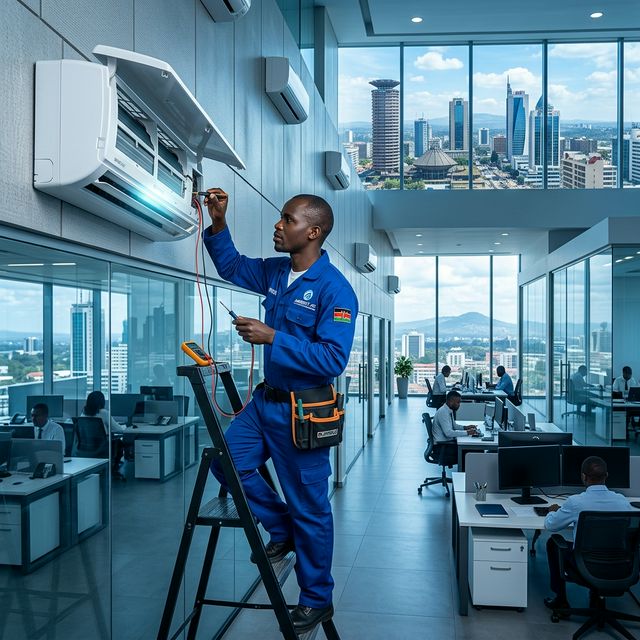
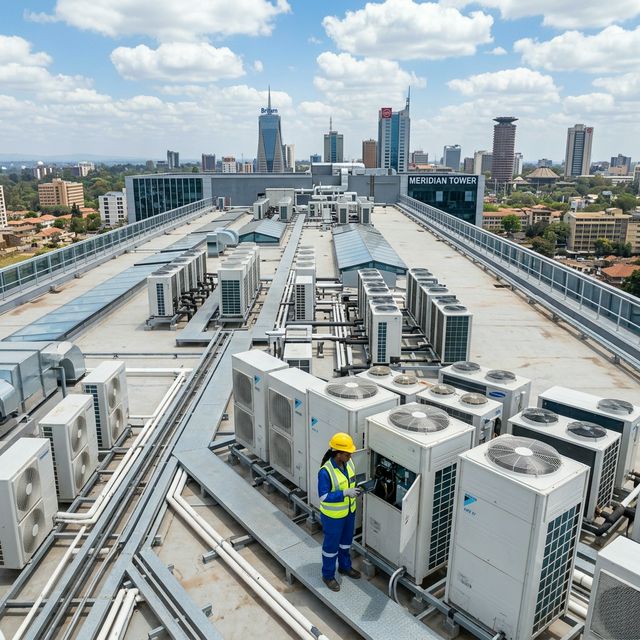
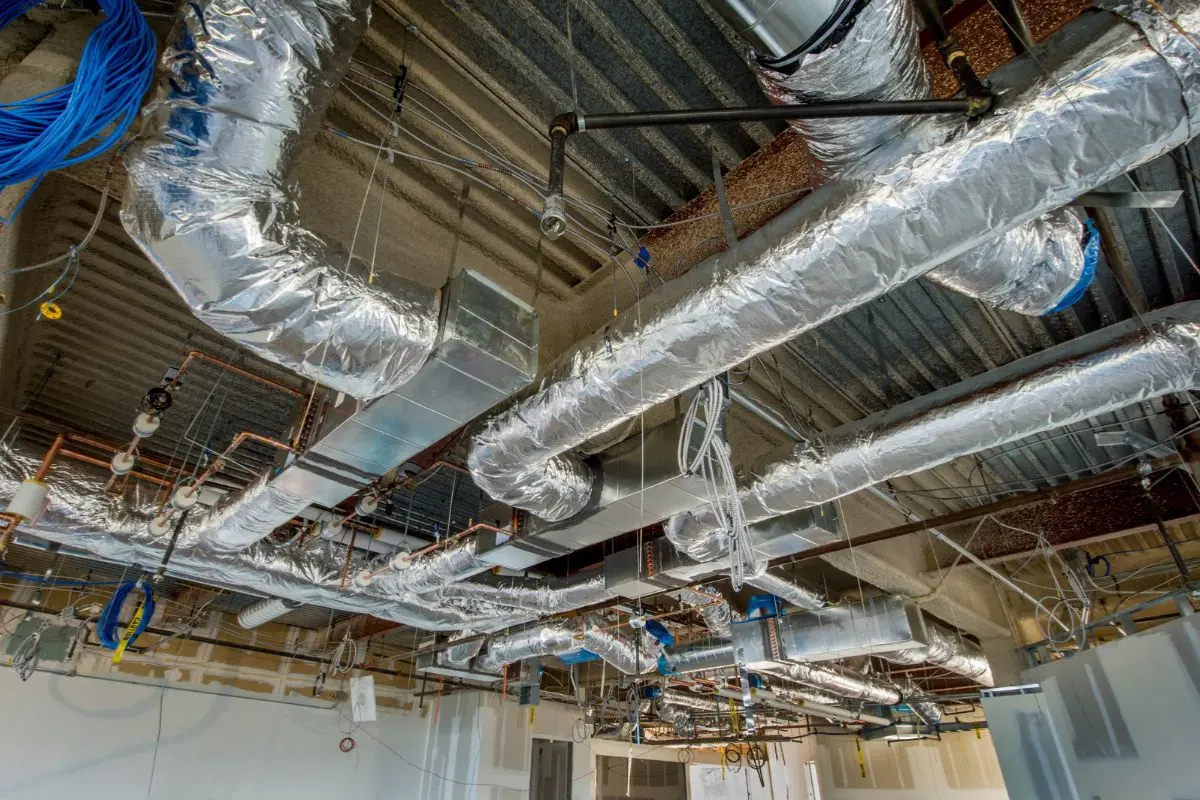
Ventilation & Extractor Fans in Kenya (2025) — The Complete Guide
By Spinel Dynamics Group | Kenya’s Leading HVAC & Ventilation Specialists | Updated June 2025
Introduction: Why Ventilation and Extractor Fans Matter in Kenya
Every building breathes. Or at least, every building should. Fresh air supply, stale air removal, moisture control, heat extraction, and odour management are not optional luxuries in a well-designed building — they are functional necessities that directly affect the health, comfort, productivity, and safety of the people inside.
In Kenya, the importance of proper ventilation is frequently underestimated. Rapid urbanisation across Nairobi, Mombasa, Kisumu, and secondary towns has produced dense building stock where natural ventilation through windows and openings is increasingly inadequate — blocked by neighbouring buildings, compromised by security requirements, or simply insufficient for the internal heat and moisture loads generated by modern occupancy patterns and equipment. The result is buildings that are stuffy, humid, odorous, and in the worst cases, genuinely unhealthy — contributing to respiratory problems, mould growth, structural moisture damage, and fire risk in commercial kitchens.
Ventilation extractor fans are the mechanical solution to these problems. From the simple bathroom extractor fan in a Nairobi apartment to the industrial-grade axial fans serving a Mombasa processing plant, the principles are the same — move air deliberately, efficiently, and reliably to create the indoor environment that people and processes need.
This guide, produced by Spinel Dynamics Group, Kenya’s leading HVAC and ventilation specialists, covers everything you need to know about ventilation and extractor fans in Kenya — the types available, how they work, how to select the right system, how they are installed, and how to maintain them for long-term reliable performance.
Table of Contents
- What is Mechanical Ventilation?
- Why Natural Ventilation is Often Insufficient in Kenya
- Types of Ventilation and Extractor Fans in Kenya
- How Extractor Fans Work
- Key Applications of Ventilation Fans in Kenya
- How to Select the Right Extractor Fan
- Ventilation Standards and Air Change Rates
- Leading Extractor Fan Brands in Kenya
- Mechanical Ventilation System Design
- Extractor Fan Installation in Kenya
- Ventilation for Commercial Kitchens in Kenya
- Ventilation for Bathrooms and Toilets in Kenya
- Industrial Ventilation in Kenya
- Car Park Ventilation in Kenya
- Extractor Fan Maintenance in Kenya
- Common Ventilation Problems in Kenya and How to Solve Them
- Why Choose Spinel Dynamics Group for Ventilation in Kenya
- Frequently Asked Questions
1. What is Mechanical Ventilation?
Mechanical ventilation is the deliberate movement of air through a building using powered fans, ductwork, and associated controls — as opposed to natural ventilation, which relies on wind pressure and thermal buoyancy to move air through openings. Mechanical ventilation systems can be designed to extract stale air from a building (extract-only systems), supply fresh air into a building (supply-only systems), or do both simultaneously (balanced mechanical ventilation or heat recovery ventilation systems).
An extractor fan is the most fundamental component of a mechanical ventilation system — a motor-driven fan that draws air from an interior space and exhausts it to the outside. Extractor fans range from tiny 100mm diameter bathroom fans consuming less than 10 watts of electricity, to enormous industrial axial fans over a metre in diameter moving tens of thousands of cubic metres of air per hour.
Mechanical ventilation through extractor fans is a specialist service provided by Spinel Dynamics Group across Kenya, covering residential, commercial, industrial, and institutional applications.
2. Why Natural Ventilation is Often Insufficient in Kenya
Kenya’s urban building environment presents specific challenges that make natural ventilation increasingly inadequate for many applications.
Dense urban development. In Nairobi’s high-density areas — Westlands, Kilimani, Upperhill, the CBD, and rapidly developing satellite towns like Ruaka and Kikuyu — buildings are constructed close together, blocking the natural wind flows that drive cross-ventilation. A building surrounded by taller neighbours on all sides may receive almost no useful natural ventilation regardless of how many windows it has.
Security requirements. Kenya’s urban security environment means that windows in ground-floor and lower-floor spaces are frequently permanently barred, louvred, or otherwise restricted — eliminating the opening area needed for meaningful natural ventilation.
Building depth. Modern commercial buildings in Kenya — particularly open-plan offices, retail outlets, and warehouses — are often too deep for natural ventilation to reach internal spaces effectively. A building 20 metres deep cannot be naturally ventilated through facade openings alone.
Internal heat and moisture loads. Modern buildings generate significant internal heat from computers, servers, kitchen equipment, lighting, and occupants. They also generate moisture from cooking, washing, and respiration. Natural ventilation is rarely sufficient to manage these loads, particularly during Nairobi’s warm dry seasons when ambient temperatures reduce the thermal buoyancy that drives natural airflow.
Specific extraction requirements. Kitchens, bathrooms, laboratories, and industrial processes generate odours, humidity, grease vapour, chemical fumes, and heat that must be positively extracted — not merely diluted by natural ventilation. Only mechanical extraction can deliver the controlled, reliable air removal these applications need.
3. Types of Ventilation and Extractor Fans in Kenya
Axial Fans
Axial fans move air parallel to the fan shaft — air enters and exits in the same axial direction. They are the most common fan type for general ventilation applications and are characterised by high airflow volumes at relatively low static pressures. Axial fans are widely used for wall-mounted extract ventilation in bathrooms, kitchens, offices, and light industrial applications. They are available from compact 100mm units for domestic bathrooms to large-diameter industrial units for warehouses and factories.
Centrifugal Fans
Centrifugal fans move air perpendicular to the fan shaft, using centrifugal force to accelerate air outward through an impeller. They develop higher static pressures than axial fans of equivalent size, making them better suited for duct systems with significant resistance — longer duct runs, multiple bends, or high-resistance grilles and filters. Centrifugal fans are the standard choice for ducted mechanical ventilation systems in offices, hotels, hospitals, and commercial buildings across Kenya.
Mixed Flow Fans
Mixed flow fans combine characteristics of axial and centrifugal designs, providing a useful middle ground of reasonable airflow volume and moderate static pressure capability in a compact, low-noise package. They are increasingly popular for residential and light commercial ducted ventilation applications where noise is a concern.
Inline Duct Fans
Inline duct fans are installed within the ventilation ductwork rather than at the point of air extract or supply. They are used to boost airflow in long duct runs, serve multiple extract points from a single fan, or provide central ventilation for multiple rooms or zones. Inline fans are a common solution in Kenya for ventilating multiple bathrooms or toilets in apartment buildings from a single rooftop exhaust point.
Roof Extract Fans
Roof-mounted centrifugal or axial fans draw air vertically upward through ductwork and exhaust it directly from the roof. They are widely used in Kenya for commercial kitchens, factory ventilation, toilet core extraction in multi-storey buildings, and any application where a high extraction point is advantageous. Roof fans are typically weatherproofed for outdoor installation and may include bird and insect screens, backdraught shutters, and variable speed drives.
Kitchen Canopy Extract Fans
Commercial kitchen canopy systems combine a stainless steel grease collection canopy positioned above cooking equipment with a powerful extract fan — either roof-mounted or wall-mounted — that draws grease-laden vapour, heat, and steam through the canopy and exhausts it outside. These systems are essential for any commercial kitchen in Kenya and are a fire safety requirement under Kenyan building regulations.
Toilet and Bathroom Extract Fans
Small axial or centrifugal extract fans installed in ceilings or walls of bathrooms, toilets, and en-suite spaces. They extract moisture, odour, and stale air directly from the space, typically discharging through short duct runs to an external wall or roof. In Kenya’s apartment buildings and office toilet cores, these fans run continuously or are triggered by light switches or humidity sensors.
Carpark Ventilation Fans
Basement and enclosed carparks generate carbon monoxide from vehicle exhausts, creating a serious health and safety hazard without adequate mechanical ventilation. Carpark ventilation systems use jet fans (impulse fans) to create controlled airflow patterns across the carpark floor, sweeping contaminated air toward extract points where roof or wall fans exhaust it to atmosphere. CO monitoring systems automatically activate or increase fan speed when carbon monoxide levels rise above safe thresholds.
Smoke Extract Fans
High-temperature smoke extract fans are engineered to continue operating at elevated temperatures — typically 300°C for two hours or 400°C for two hours depending on the classification — in the event of a building fire. They form a critical part of building fire safety systems, maintaining tenable conditions for occupant evacuation and fire brigade access. Smoke extract fans must be certified to relevant standards and are a regulatory requirement in Kenya for shopping malls, multi-storey carparks, atriums, and large assembly buildings.
Heat Recovery Ventilation (HRV) Units
Heat recovery ventilation units simultaneously extract stale air and supply fresh air, passing the two airstreams through a heat exchanger that recovers thermal energy from the outgoing air and transfers it to the incoming air. In Nairobi’s cooler highland climate, HRV units can recover 70–90% of the heat that would otherwise be lost with the extracted air — reducing the heating load on air conditioning systems and improving overall building energy efficiency.
4. How Extractor Fans Work
At their most fundamental, extractor fans work by creating a pressure differential. The rotating fan impeller reduces the air pressure on its inlet side (inside the building) and increases it on the outlet side (outside or in the ductwork). This pressure differential drives airflow from the higher-pressure interior toward the lower-pressure outlet — extracting stale air from the building.
For this process to work effectively, replacement air must be able to enter the building to replace the extracted air. An extract-only ventilation system must therefore be designed alongside adequate air inlet provision — either through supply air grilles, gaps under doors, or dedicated supply air fans. A sealed room with an extract fan but no air inlet path will not ventilate effectively, as the fan will quickly equalise pressure and airflow will drop to near zero.
The performance of an extractor fan is characterised by two key parameters: its airflow volume (measured in cubic metres per hour, m³/h, or litres per second, l/s) and its static pressure capability (measured in Pascals, Pa). Every installation has a system resistance — determined by the duct length, diameter, number of bends, and terminal grille — and the fan must develop enough static pressure to overcome this resistance while delivering the required airflow. Matching fan performance to system resistance is the essence of fan selection engineering.
5. Key Applications of Ventilation Fans in Kenya
Residential Apartments and Homes
Bathroom and toilet extract fans are the most common residential ventilation application. In Kenya’s increasingly compact urban apartments — particularly in high-density developments in Ruaka, Kasarani, Embakasi, and South B/C — proper bathroom extraction prevents the mould growth, structural moisture damage, and persistent odour that inadequate ventilation creates. Kitchen extract hoods with fans serve to remove cooking odours, grease vapour, and steam from cooking areas.
Commercial Offices
Modern open-plan offices in Nairobi’s commercial districts generate significant internal heat from people and computers. Mechanical supply and extract ventilation — often integrated with the air conditioning system — maintains fresh air levels, controls CO₂ buildup, and supports the air conditioning system in managing internal loads. Toilet core extract ventilation is a standard requirement in every commercial office building.
Hotels and Serviced Apartments
Hotels require mechanical ventilation in every guest bathroom, in commercial kitchens, in laundry facilities, in car parks, and in back-of-house service areas. The quality and quietness of bathroom extract fans directly impacts guest experience — a noisy or ineffective bathroom fan is a common source of guest complaints in Kenya’s hospitality sector.
Hospitals and Healthcare Facilities
Healthcare ventilation is a specialist discipline with strict requirements around air change rates, pressure relationships between spaces (positive pressure in operating theatres, negative pressure in isolation rooms), filtration standards, and noise levels. Spinel Dynamics Group has specific experience designing and installing ventilation systems for Kenya’s healthcare facilities.
Industrial and Manufacturing Facilities
Factories, processing plants, and warehouses in Kenya’s industrial areas — Athi River, Industrial Area, Mombasa port vicinity — require industrial-scale ventilation to manage process heat, chemical fumes, dust, and moisture. Incorrect industrial ventilation creates health and safety risks, equipment damage, and regulatory non-compliance.
Commercial Kitchens and Restaurants
Commercial kitchen ventilation is perhaps the most critical and most regulated ventilation application in Kenya. Grease vapour, heat, steam, and combustion products from commercial cooking equipment must be positively extracted through a properly designed canopy and ductwork system. Inadequate kitchen ventilation is a primary cause of commercial kitchen fires in Kenya. Spinel Dynamics Group designs and installs complete commercial kitchen ventilation systems across Nairobi, Mombasa, and Kenya-wide.
Schools and Educational Facilities
Classrooms with poor ventilation have elevated CO₂ levels that impair cognitive function and concentration — a direct impact on learning outcomes. Kenya’s growing investment in quality school infrastructure increasingly includes mechanical ventilation for classrooms, laboratories, and sanitary facilities.
Carparks
Basement and semi-enclosed carparks in Nairobi’s commercial and residential developments — increasingly common as land values drive multi-storey construction — require mechanical carpark ventilation systems with CO monitoring to manage vehicle exhaust safely.
6. How to Select the Right Extractor Fan
Selecting the correct extractor fan for a specific application involves several engineering considerations that go well beyond simply buying the biggest or cheapest unit available.
Determine the Required Airflow Volume
The required airflow is determined by the volume of the space and the required number of air changes per hour (ACH) for the application — a standard that varies by space type and is defined in ventilation guidelines and building regulations. A 10 m³ bathroom requiring 15 ACH needs 150 m³/h of extract airflow. A 200 m³ commercial kitchen requiring 60 ACH needs 12,000 m³/h. Getting this calculation right is fundamental — an undersized fan will not ventilate adequately, and an oversized fan may be noisy, energy-wasteful, and create uncomfortable draughts.
Calculate System Resistance
Every metre of ductwork, every bend, every grille, and every filter adds resistance to the airflow. The fan must develop enough static pressure to overcome this total system resistance while still delivering the required airflow volume. This is the fan-system matching problem — and it is where many informal installations go wrong, selecting a fan based only on airflow volume while ignoring system resistance.
Consider Noise Requirements
Fan noise is a significant concern in residential, hospitality, and healthcare applications. Fan noise is measured in decibels (dB(A)) and increases sharply with airflow volume and fan speed. For bedrooms and hotel rooms, fans rated below 25–30 dB(A) at the installation point are desirable. For bathrooms and offices, below 35–40 dB(A) is acceptable. For industrial applications, noise may be less critical but must still comply with occupational health standards.
Assess the Environment
Kenya’s varied environments create specific fan selection challenges. Coastal installations in Mombasa require fans with corrosion-resistant materials — marine-grade aluminium impellers, stainless steel fasteners, and epoxy-coated housings — to resist salt-laden humid air. Industrial applications may require explosion-proof fans if flammable vapours are present. Kitchen applications require grease-resistant fans with access for cleaning.
Select the Correct Fan Type
As described above, axial fans suit low-resistance, high-volume applications. Centrifugal fans suit higher-resistance ducted systems. Inline fans suit long duct runs or multi-point extraction. Roof fans suit large-volume roof extract applications. Matching the fan type to the application and system characteristics is a key selection decision.
7. Ventilation Standards and Air Change Rates
Kenya’s building regulations reference ventilation standards that specify minimum air change rates for different space types. These standards inform the design of mechanical ventilation systems to ensure adequate fresh air provision and pollutant removal. The following are commonly applied benchmarks:
| Space Type | Recommended Air Changes per Hour |
|---|---|
| Domestic bathroom / toilet | 8 – 15 ACH |
| Commercial toilet / WC | 10 – 15 ACH |
| Office (general) | 4 – 8 ACH |
| Commercial kitchen | 30 – 60 ACH |
| Hospital ward | 6 – 10 ACH |
| Operating theatre | 15 – 25 ACH (plus filtration) |
| Car park (basement) | 6 – 10 ACH |
| Warehouse / light industrial | 4 – 6 ACH |
| Heavy industrial / process | 10 – 30 ACH (application dependent) |
| Server room / data centre | 20 – 40 ACH |
| Restaurant / dining | 8 – 12 ACH |
| Laboratory | 6 – 12 ACH |
These are general benchmarks. Specific projects may require more detailed analysis based on occupancy patterns, equipment heat loads, regulatory requirements, and local authority conditions. Spinel Dynamics Group’s ventilation engineers carry out full ventilation calculations for every project to ensure compliance and performance.
8. Leading Extractor Fan Brands in Kenya
Systemair
Systemair is one of the world’s leading ventilation equipment manufacturers, with a comprehensive range covering residential, commercial, and industrial applications. Their products are widely regarded for reliability, energy efficiency, and availability of spare parts. Systemair’s inline fans, roof extract fans, and centrifugal fans are widely specified in Kenya’s commercial building sector.
Soler & Palau (S&P)
Spain’s Soler & Palau is one of Europe’s largest ventilation specialists, producing an extensive range of axial fans, centrifugal fans, inline fans, and heat recovery units. Their products are known for quiet operation and high efficiency, making them a popular choice for Kenya’s hospitality and healthcare sectors where noise is a concern.
Elta Fans
Elta Fans is a British manufacturer with a strong reputation in commercial and industrial ventilation. Their centrifugal and axial fans are widely used in Kenya’s commercial buildings, with particular strength in high-specification commercial and industrial applications.
Greenwood Airvac
Greenwood Airvac produces a widely used range of domestic and light commercial extract fans that are popular in Kenya’s residential and small commercial sectors. Their products offer good reliability at accessible price points.
Vortice
Italian manufacturer Vortice produces a comprehensive range of residential and commercial ventilation products including axial fans, inline fans, and heat recovery units. Their products are well-regarded for build quality and quiet operation.
Fantech
Fantech produces a broad range of inline, centrifugal, and mixed flow fans for commercial and industrial applications. They are commonly specified for medium-to-large commercial ventilation projects in Kenya.
Spinel Dynamics Group sources ventilation equipment from leading international manufacturers to ensure every installation uses reliable, efficient fans with genuine spare parts availability and manufacturer support in Kenya. Contact Spinel Dynamics Group to discuss the most appropriate brand and model for your specific application.
9. Mechanical Ventilation System Design
A mechanical ventilation system is more than a fan bolted to a wall. A properly designed system integrates the fan with a ductwork distribution network, terminal grilles and diffusers, controls, and where required, air treatment components such as filters, heat exchangers, and attenuators. Good system design ensures that the right quantity of air is delivered to and extracted from the right locations, at the right velocities, with acceptable noise levels, and at the lowest practical energy cost.
Ductwork Design
The ductwork network distributes airflow from the central fan to extract grilles or supply diffusers across the building. Duct sizing is critical — undersized ducts create high velocities, excessive noise, and high system resistance that reduces fan performance. Oversized ducts waste space and material cost. Duct materials in Kenya include galvanised steel sheet (the standard for commercial and industrial applications), flexible ducting (for short connections in residential and light commercial work), and PVC or stainless steel for specialist applications such as chemical extraction or kitchen grease duct systems.
Grilles, Diffusers, and Terminals
The terminal devices — extract grilles and supply diffusers — control how air enters and leaves the ventilated space. They must be correctly sized for the airflow at each point to maintain acceptable face velocities and avoid uncomfortable draughts. Adjustable grilles allow airflow balancing across the system after installation.
Controls and Automation
Modern ventilation systems incorporate a range of control options: simple on/off switching with the room light switch, humidity sensors that activate fans when moisture levels rise, CO₂ sensors that modulate fan speed based on actual occupancy levels, timer controls, building management system (BMS) integration, and remote monitoring. Demand-controlled ventilation — where fan speed is automatically varied in response to actual air quality — is increasingly specified in Kenya’s energy-conscious commercial buildings as it avoids the energy waste of running fans at full speed in lightly occupied spaces.
Fire and Smoke Considerations
Ventilation ductwork that passes through fire compartment boundaries must incorporate fire dampers — motorised or fusible-link dampers that close automatically in a fire to prevent the duct system from acting as a fire and smoke propagation pathway. This is a regulatory requirement in Kenya for commercial buildings and is often overlooked in informal installations. Spinel Dynamics Group designs all ventilation systems with appropriate fire compartmentation provisions.
10. Extractor Fan Installation in Kenya
Professional extractor fan installation by Spinel Dynamics Group follows a structured process:
Site survey and design. Before any installation begins, the space is surveyed, the ventilation requirement is calculated, and the system is designed. This includes fan selection, ductwork routing, terminal locations, and control strategy.
Structural preparation. Wall or ceiling penetrations are core-drilled or cut to the correct size for the duct or fan housing. For roof-mounted fans, weatherproof penetrations through the roof structure are prepared.
Ductwork installation. Duct runs are fabricated and installed to the design layout, correctly supported, insulated where required, and sealed at all joints to prevent air leakage.
Fan installation and mounting. The fan unit is installed in its correct location — wall, ceiling, inline duct position, or roof — securely mounted with appropriate vibration isolation to minimise noise transmission to the building structure.
Electrical connection. Fans are wired to their power supply and controls, correctly fused, earthed, and connected to switching, sensing, or BMS systems as specified.
Commissioning and airflow balancing. Once installed, the system is commissioned by measuring actual airflow at each terminal and comparing against design values. Terminal grilles are adjusted to balance airflow distribution across the system. Fan speed controls are set as required. All commissioning data is documented.
Handover and training. Operators are briefed on system operation, filter replacement schedules, and routine maintenance requirements.
11. Ventilation for Commercial Kitchens in Kenya
Commercial kitchen ventilation deserves particular attention because it is both the most critical and most frequently poorly executed ventilation application in Kenya’s built environment. A commercial kitchen without adequate ventilation is a health hazard, a fire risk, and an uncomfortable working environment that drives staff turnover.
Why Commercial Kitchen Ventilation is Critical
Commercial cooking produces enormous quantities of heat — a single commercial range can generate 15–25 kW of heat. It also produces grease vapour that condenses on surfaces if not extracted, creating progressive fire risk as grease accumulates in ductwork and on surfaces. Steam and moisture from cooking and dishwashing create humidity that damages building fabric and creates unhygienic working conditions. Carbon dioxide and combustion products from gas cooking equipment must be positively diluted and extracted.
Components of a Commercial Kitchen Ventilation System
A complete commercial kitchen ventilation system for a Kenyan restaurant, hotel kitchen, or institutional catering facility includes a stainless steel extraction canopy positioned above all cooking equipment, a grease filtration system within the canopy (typically baffle filters or mesh filters that must be regularly cleaned), a grease duct connecting the canopy to the extract fan — fabricated in stainless steel or heavy-gauge galvanised steel with access panels for cleaning, a high-temperature rated extract fan — either roof-mounted or wall-mounted with appropriate grease resistance, and a make-up air supply system to replace the extracted air, which may incorporate heating or cooling to condition the incoming air.
Regulatory Requirements
Kenya’s building regulations, fire safety regulations, and public health licensing requirements all have provisions relating to commercial kitchen ventilation. Local authority environmental health officers inspect commercial kitchen ventilation as part of food business licensing. Inadequate ventilation is a common cause of licence refusal or closure orders for food businesses in Nairobi and Mombasa.
Spinel Dynamics Group designs and installs complete commercial kitchen ventilation systems that meet regulatory requirements and provide genuinely effective working environments. Their experience covers hotel kitchens, restaurant chains, institutional catering, hospital kitchen facilities, and industrial food processing operations across Kenya.
12. Ventilation for Bathrooms and Toilets in Kenya
Bathroom and toilet extract ventilation is the most widespread ventilation application in Kenya’s residential and commercial building stock. Despite its apparent simplicity, poorly specified or installed bathroom ventilation is responsible for enormous amounts of mould damage, structural moisture problems, and persistent odour in Kenya’s buildings.
Residential Bathroom Ventilation
For a standard domestic bathroom or en-suite toilet in a Kenyan apartment or house, a ceiling or wall-mounted axial fan rated at 100–150 m³/h is typically adequate. The fan should discharge through a short, insulated duct run — no longer than 3–4 metres with no more than one or two bends — to an external wall terminal or roof cowl. Fan controls options include: continuous running at low speed with boost on demand, humidity-sensor activation when relative humidity exceeds a set threshold (typically 70%), or light-switch activation with an overrun timer that keeps the fan running for 10–15 minutes after the light is switched off.
Multi-Toilet Core Ventilation in Commercial Buildings
In multi-storey office buildings, hotels, and apartment blocks, individual bathroom fans on each floor discharging through separate duct runs to individual external wall penetrations quickly becomes impractical — too many penetrations, too many individual fan units to maintain, and conflicts with the building facade. The standard solution is a centralised toilet core extract system: a single high-performance centrifugal or mixed flow fan — typically roof-mounted — connected to a riser duct that serves extract grilles on every floor’s toilet core. A single fan and single roof penetration serves the entire building’s toilet ventilation needs. Spinel Dynamics Group designs and installs these centralised systems in commercial office buildings, apartment blocks, and hotels across Nairobi and Kenya-wide.
13. Industrial Ventilation in Kenya
Kenya’s industrial sector — manufacturing, food processing, chemical production, warehousing, and logistics — presents ventilation challenges of a different scale and complexity to commercial building applications. Industrial ventilation serves multiple purposes simultaneously: controlling process heat to protect equipment and workers, diluting or capturing chemical fumes and dust to meet occupational health standards, managing moisture in food processing and brewing operations, and providing general fresh air for worker comfort and productivity.
General Industrial Dilution Ventilation
For factories and warehouses generating diffuse heat and low concentrations of general air pollutants, dilution ventilation using large-diameter roof-mounted axial fans provides cost-effective air change rates. Natural air inlets — louvred wall openings, ridge ventilators — work in combination with mechanical extract fans to drive airflow across the factory floor.
Local Exhaust Ventilation (LEV)
Where specific processes generate concentrated fumes, dust, vapour, or heat at a defined point — a welding station, a chemical mixing vessel, a sanding operation — local exhaust ventilation captures the pollutant at source before it disperses into the general workspace. LEV systems typically consist of a capture hood positioned close to the source, connected through ductwork to a filtration unit and exhaust fan. LEV design must ensure adequate capture velocity at the hood face for the specific contaminant and process — a technical calculation that requires knowledge of contaminant generation rates and toxicological properties.
Explosion-Proof Ventilation
Factories handling flammable solvents, gases, or dusts require ATEX-certified (explosion-proof) fans and electrical equipment throughout the ventilated zone. The fan motor, impeller, and all electrical components must be constructed to prevent ignition of the flammable atmosphere. This is a specialist area where the consequences of using standard fans in hazardous zones are potentially catastrophic — Spinel Dynamics Group specifies and installs certified explosion-proof ventilation systems for applicable industrial clients.
14. Car Park Ventilation in Kenya
As Nairobi’s commercial and residential property sector builds upward and underground, basement and podium car parks have become standard features of mid-to-high-end developments across Westlands, Upperhill, Kilimani, and the CBD. These enclosed spaces accumulate carbon monoxide from vehicle exhausts to potentially lethal concentrations without adequate mechanical ventilation.
Car Park Ventilation Design
Car park ventilation in Kenya is typically designed using one of two approaches. The traditional approach uses a network of supply and extract ductwork with fans at each end, providing uniform air distribution across the parking area. The increasingly preferred modern approach uses jet fans — small, high-velocity fans mounted at ceiling level — that create controlled airflow patterns across the parking floor, sweeping contaminated air horizontally toward extract points without requiring extensive ductwork. Jet fan systems are faster to install, less expensive in material cost, and easier to balance than ducted systems.
CO Monitoring and Control
All enclosed car parks in Kenya’s commercial buildings should incorporate carbon monoxide monitoring systems that automatically activate or ramp up ventilation fans when CO concentrations approach unsafe levels — typically set to activate at 25–50 ppm CO. This demand-controlled operation saves energy during low-occupancy periods while ensuring safety when the car park is in heavy use.
15. Extractor Fan Maintenance in Kenya
Like all mechanical equipment, extractor fans require regular maintenance to maintain performance and extend service life. Kenya’s dusty urban environment means that fan blades and motor cooling passages accumulate dust faster than in cleaner environments — making regular cleaning particularly important.
Monthly Checks
Visually inspect accessible fans for dust accumulation on impeller blades and motor casing. Clean impeller blades with a soft brush or compressed air if significant dust buildup is visible. Verify that the fan is running by checking for airflow at the extract grille. Listen for any unusual noise — rattling, squealing, or grinding — that may indicate bearing wear or impeller imbalance.
Quarterly Maintenance
Remove fan covers and clean impeller blades thoroughly. Check and clean backdraught shutters to ensure they open freely when the fan runs and close fully when it stops. Inspect flexible duct connections for any splits or disconnections. Verify that terminal grilles are clean and unobstructed.
Annual Service
Inspect fan motor bearings — many smaller fans use sealed bearings that cannot be lubricated, but larger commercial fans may have grease nipples that require periodic regreasing. Check electrical connections for corrosion or looseness. Measure fan airflow output and compare to original commissioning data — a significant reduction in airflow indicates impeller wear, motor performance degradation, or increased system resistance that requires investigation. Inspect all ductwork for leakage, damage, or blockages.
Commercial Kitchen Fan Maintenance
Commercial kitchen extract fans accumulate grease over time and require more intensive maintenance. The frequency depends on the volume and type of cooking but monthly inspection of grease filters, quarterly professional cleaning of the grease duct, and annual inspection of the fan impeller and housing for grease accumulation are typical requirements for a busy Kenyan restaurant or hotel kitchen.
Spinel Dynamics Group offers maintenance contracts for ventilation systems across Kenya, covering regular inspections, cleaning, and emergency repairs. Contact info@spineldynamics.com to discuss a maintenance arrangement for your ventilation installation.
16. Common Ventilation Problems in Kenya and How to Solve Them
Insufficient Airflow
The fan runs but the space still feels stuffy, humid, or odorous. Causes include an undersized fan for the space volume, excessive duct resistance from a poorly designed or damaged duct system, blocked or dirty air inlet provisions, or accumulated dust on fan impeller blades reducing performance. Solution requires professional diagnosis to identify the specific cause — airflow measurement, system resistance assessment, and fan performance testing.
Excessive Noise
Fan noise is a frequent complaint in residential and hospitality applications. Causes include an oversized fan running at unnecessarily high speed, a fan installed without adequate vibration isolation transmitting motor vibration to the building structure, loose impeller or fan housing components, bearing wear in older fans, or turbulence noise from ductwork that is too small for the airflow. Solutions range from vibration isolation mounting, fan speed reduction via controls, duct upsizing, to fan replacement in cases of irreparable bearing wear.
Mould and Condensation Persisting Despite Fan Operation
If mould and condensation persist despite the extract fan operating, the most common causes are inadequate replacement air provision preventing the fan from moving the required airflow, an undersized fan for the moisture generation rate of the space, or a duct that has become disconnected or blocked preventing air from actually being exhausted outside. In Nairobi’s cooler highland climate, condensation on cold duct surfaces can block insulation-free ducts with ice or condensate — insulated duct runs prevent this.
Backdraught
Backdraught — where air flows backward through the fan from outside into the building — occurs when the building is at higher pressure than the exterior, typically caused by wind pressure on the building facade. Backdraught shutters on all extract fans prevent reverse airflow. If backdraught is a persistent problem, fan selection should specify a unit with higher static pressure capability to overcome the wind-induced pressure differential.
Fan Failure
Complete fan failure — motor burnout or bearing seizure — typically results from overheating due to blocked ventilation passages in the motor, long-term overloading due to excessive system resistance, or simply end-of-life failure of motor windings or bearings. Prompt replacement is essential — a failed bathroom fan in a Kenyan apartment causes rapid mould growth within weeks. Spinel Dynamics Group maintains stocks of common fan replacement units and can typically respond to emergency call-outs across Nairobi within 24 hours.
17. Why Choose Spinel Dynamics Group for Ventilation in Kenya?
Spinel Dynamics Group is Kenya’s leading full-service HVAC and ventilation company, with proven expertise across every type of ventilation and extractor fan application in the Kenyan market. Here is what sets them apart:
Engineering-led approach. Every ventilation project begins with proper engineering — air change rate calculations, fan-system matching, ductwork design, and control strategy. Spinel Dynamics Group does not guess at fan sizes or duct routes — every system is calculated and designed before installation begins.
Full-scope capability. From a single bathroom extract fan replacement in a Nairobi apartment to a complete mechanical ventilation system for a multi-storey commercial building, Spinel Dynamics Group has the skills, equipment, and experience to deliver. Their scope covers mechanical ventilation, extractor fans, commercial kitchen ventilation, industrial ventilation, car park ventilation systems, and smoke extract systems.
Integration with HVAC and air conditioning. Ventilation and air conditioning are complementary systems that work best when designed together. Spinel Dynamics Group’s expertise across both disciplines — they are also Kenya’s leading air conditioning specialists — means ventilation systems are designed to complement and support air conditioning performance rather than conflict with it.
Quality equipment sourcing. Spinel Dynamics Group specifies ventilation equipment from leading international manufacturers with genuine Kenya availability and support — not grey-market or counterfeit products.
Geographic reach. Active across Nairobi, Mombasa, Kisumu, and the wider East African region for commercial projects. Their team can reach any location across Kenya for site surveys, installations, and maintenance.
Maintenance and support. Ventilation systems require regular maintenance to perform as designed. Spinel Dynamics Group offers structured maintenance contracts, emergency breakdown response, and remote monitoring systems for critical ventilation applications.
Contact Spinel Dynamics Group at +254 714 821 020 or info@spineldynamics.com. Offices at Aqua Plaza, First Floor, Murang’a Road, Nairobi. Monday–Friday 8:00 AM – 6:00 PM, Saturday 9:00 AM – 2:00 PM.
18. Frequently Asked Questions
What size extractor fan do I need for my bathroom in Kenya? For a standard domestic bathroom up to 8 m³ in volume, a 100mm diameter axial fan rated at 95–100 m³/h is typically adequate. For larger bathrooms, en-suites with steam showers, or spaces with longer duct runs, a higher-capacity fan or an inline centrifugal fan may be required. Spinel Dynamics Group can advise on the correct specification for your specific space — contact them at +254 714 821 020.
How often should extractor fans be serviced in Kenya? Domestic bathroom fans should be cleaned quarterly and professionally inspected annually. Commercial kitchen fans require monthly grease filter cleaning and more intensive annual servicing. Industrial fans should be inspected monthly and professionally serviced every six months. Coastal installations in Mombasa require more frequent inspection due to salt-laden air accelerating corrosion.
Can I install an extractor fan myself in Kenya? A basic domestic bathroom fan replacement in an existing installation may be within the capability of a competent handyman, but any new installation, commercial application, or system involving new ductwork and electrical wiring should be carried out by a qualified ventilation contractor. Incorrect fan sizing, duct routing, or electrical installation creates problems that are often more expensive to correct than the original professional installation would have cost.
What is the difference between an extractor fan and a ventilation system? An extractor fan is a single fan unit that extracts air from a specific space. A ventilation system is a complete installation comprising fans, ductwork, terminals, controls, and possibly air treatment components that ventilates an entire building or multiple spaces in a coordinated way. An extractor fan is typically one component within a larger ventilation system.
Do I need mechanical ventilation if I have air conditioning in Kenya? Yes, in most cases. Air conditioning recirculates internal air to cool it — it does not introduce fresh air from outside. Without mechanical ventilation, CO₂ levels and pollutant concentrations in air-conditioned spaces rise over time, causing stuffiness and reduced air quality despite comfortable temperatures. Good building practice combines air conditioning for temperature control with mechanical ventilation for fresh air provision and pollutant removal.
Does Spinel Dynamics Group install kitchen canopy ventilation systems? Yes. Spinel Dynamics Group designs and installs complete commercial kitchen ventilation systems including stainless steel extraction canopies, grease filtration, grease ductwork, roof or wall extract fans, and make-up air supply systems. They have extensive experience with hotel kitchens, restaurant chains, and institutional catering facilities across Kenya. Contact info@spineldynamics.com to discuss your kitchen ventilation project.
What areas does Spinel Dynamics Group cover for ventilation installation? Spinel Dynamics Group is active across Nairobi, Mombasa, Kisumu, and the wider East African region. For major commercial ventilation projects, they cover Uganda, Tanzania, and Rwanda. Contact their team to discuss projects in any location across Kenya or East Africa.
Spinel Dynamics Group — Aqua Plaza, First Floor, Murang’a Road, Nairobi | +254 714 821 020 | info@spineldynamics.com | Mon–Fri: 8:00 AM – 6:00 PM | Sat: 9:00 AM – 2:00 PM
Home | About Us | Services | Products | Mechanical Ventilation | Extractor Fans | Blog | Contact Us