Cold Room Installation in Kenya (2025) — The Complete Guide
By Spinel Dynamics Group | Kenya’s Leading HVAC & Cold Room Specialists | Updated June 2025
Introduction: Why Cold Room Installation Matters in Kenya
Kenya’s economy depends heavily on industries where temperature control is not a luxury — it is an operational necessity. From the flower farms of Naivasha supplying European markets, to the fish processors on Lake Victoria’s shores, to the pharmaceutical distributors in Nairobi’s Industrial Area, and the supermarket chains expanding rapidly across the country, the ability to store perishable goods at precise, stable temperatures is the difference between profit and loss, between safe medicine and spoiled stock, between fresh produce and waste.
Cold room installation in Kenya has grown from a niche industrial service into a mainstream requirement cutting across agriculture, food retail, hospitality, healthcare, and logistics. Yet despite this growth, the market remains poorly understood by many buyers — flooded with informal contractors offering cheap builds that fail within months, leaving business owners with spoiled inventory, costly repairs, and damaged reputations.
This guide is written by Spinel Dynamics Group, Kenya’s leading HVAC and cold room specialists, to give you everything you need to know before commissioning a cold room installation. We cover types of cold rooms, how they work, what determines quality, what the installation process involves, how to maintain your cold room, and why choosing the right contractor is the most important decision you will make.
Table of Contents
- What is a Cold Room?
- Types of Cold Rooms Available in Kenya
- Industries That Need Cold Rooms in Kenya
- Key Components of a Cold Room System
- Cold Room Installation Process in Kenya
- Factors That Determine Cold Room Quality
- Choosing the Right Cold Room Size
- Cold Room Temperature Ranges and Applications
- Energy Efficiency in Cold Room Systems
- Cold Room Maintenance in Kenya
- Common Cold Room Problems in Kenya and How to Avoid Them
- Why Choose Spinel Dynamics Group for Cold Room Installation
- Frequently Asked Questions
1. What is a Cold Room?
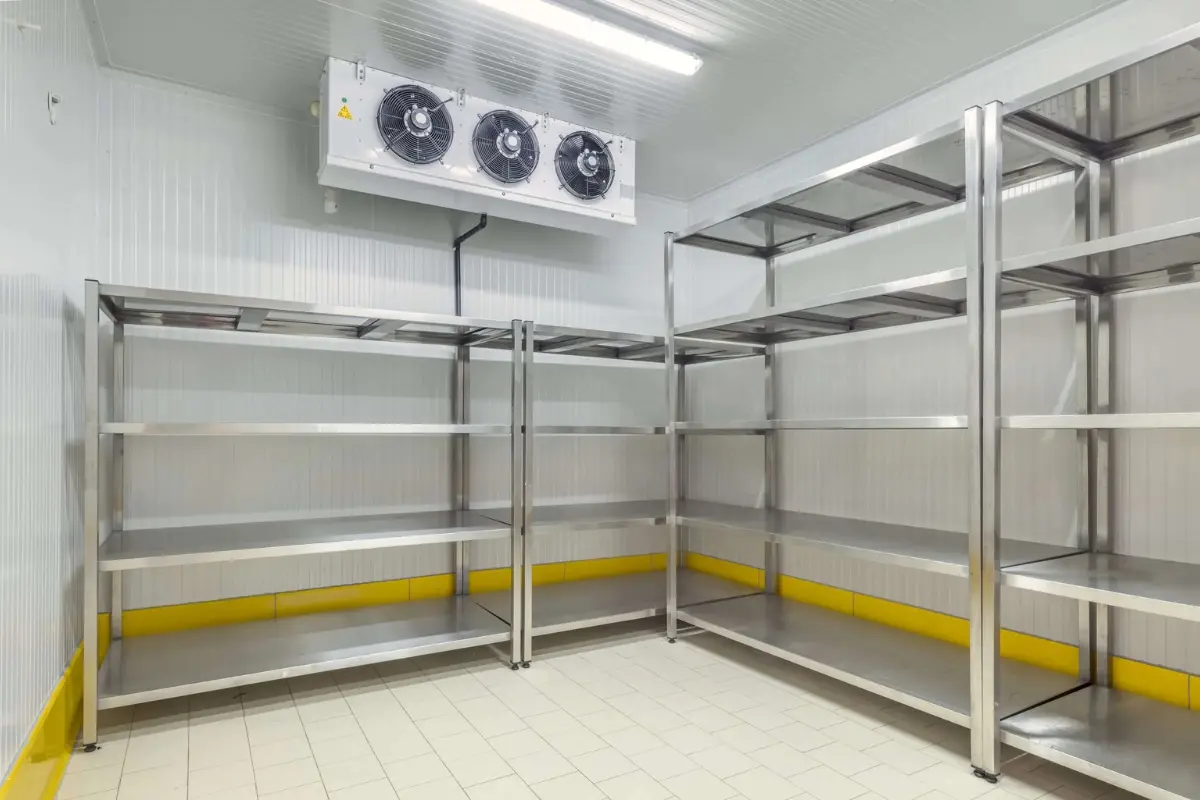
A cold room — also called a walk-in cold room, walk-in chiller, or walk-in freezer depending on its temperature range — is an insulated enclosed space designed to maintain a precisely controlled low temperature for the storage of perishable goods, temperature-sensitive products, or biological materials.
Unlike a standard domestic refrigerator or even a commercial upright fridge, a cold room is a purpose-built structure. It can range in size from a compact 6 m² unit suitable for a small restaurant kitchen to a vast 500 m² warehouse-scale facility serving a national supermarket distribution centre. The walls, ceiling, and floor are constructed from insulated panels — typically polyurethane foam sandwiched between steel skins — that minimise heat transfer between the cold interior and the ambient exterior environment.
The refrigeration system that powers a cold room is fundamentally similar in principle to a domestic fridge: a compressor, condenser, expansion device, and evaporator work together in a refrigeration cycle to extract heat from the insulated space and reject it to the outside. However, the engineering demands of maintaining large volumes at stable sub-zero or near-zero temperatures — often in tropical ambient conditions like Kenya’s — are significantly more complex than domestic refrigeration.
A well-designed and properly installed cold room is one of the most reliable pieces of infrastructure a Kenyan food, pharmaceutical, or hospitality business can invest in. A poorly designed one is an expensive liability.
2. Types of Cold Rooms Available in Kenya
Walk-In Chillers (Positive Temperature Cold Rooms)
Walk-in chillers maintain temperatures typically between +2°C and +10°C. They are the most common cold room type in Kenya, used extensively for fresh produce, dairy products, beverages, flowers, confectionery, and fresh meat. Supermarkets, hotels, restaurants, hospitals, and fresh produce exporters are the primary users. The refrigeration equipment for chillers is less intensive than freezers, and the insulation specification — typically 80–100 mm polyurethane panels — is somewhat lighter.
Walk-In Freezers (Negative Temperature Cold Rooms)
Walk-in freezers maintain temperatures typically between -18°C and -25°C. They are used for long-term storage of frozen meat, fish, poultry, ice cream, frozen vegetables, and other products requiring deep freezing. The insulation specification is heavier — typically 120–150 mm polyurethane panels — to manage the significantly larger temperature differential between the frozen interior and Kenya’s warm ambient exterior. Refrigeration equipment must also be more powerful and robust.
Blast Freezers (Blast Chillers)
Blast freezers are specialist rooms designed to rapidly reduce the core temperature of freshly cooked or freshly slaughtered products from ambient to frozen or chilled temperatures as fast as possible — typically within 90 minutes for chilling and 240 minutes for freezing. This rapid process minimises ice crystal formation in cellular structures, preserving product quality far better than slow freezing. Blast freezers are increasingly specified by Kenyan export-oriented food processors, large hotel kitchens, and catering companies.
Controlled Atmosphere (CA) Cold Rooms
Controlled atmosphere rooms go beyond temperature control to also precisely manage the levels of oxygen, carbon dioxide, and nitrogen within the storage space. This dramatically extends the shelf life of fresh produce — particularly fruits and vegetables destined for export. Kenya’s horticultural export industry, centred on Naivasha and the Central Highlands, uses CA rooms extensively for high-value products like avocados, beans, and cut flowers.
Pharmaceutical Cold Rooms
Pharmaceutical cold rooms are purpose-designed for the storage of vaccines, blood products, reagents, and temperature-sensitive medicines. They are typically built to tighter temperature tolerances — often +2°C to +8°C — with redundant refrigeration systems, continuous temperature monitoring, alarm systems, and documentation trails that satisfy regulatory requirements from Kenya’s Pharmacy and Poisons Board, WHO standards, and international pharmaceutical Good Distribution Practice (GDP) guidelines.
Modular Cold Rooms
Modular cold rooms are prefabricated, flat-pack systems that can be assembled on-site without major construction work. They are popular for businesses that need a cold room solution quickly, for locations where building-in is impractical, or for operations that may need to relocate the cold room in future. Modular rooms are available in standard sizes and can be extended by adding panels. Spinel Dynamics Group supplies and installs modular cold room systems across Kenya as part of their commercial refrigeration services.
3. Industries That Need Cold Rooms in Kenya
Supermarkets and Food Retail
Kenya’s modern retail sector has expanded dramatically, with major chains — Naivas, QuickMart, Carrefour, and Cleanshelf — operating hundreds of outlets across the country. Every supermarket back-of-house operation requires multiple cold rooms: separate chillers for fresh produce, dairy, and meat, plus freezers for frozen foods. The reliability of these cold rooms is directly tied to product freshness, waste levels, regulatory compliance, and ultimately customer trust.
Hotels and Hospitality
Nairobi’s hospitality sector — anchored by major international brands across Westlands, Upper Hill, and the CBD — and Mombasa’s resort hotel strip require large, reliable cold room infrastructure to support their kitchens. A five-star hotel kitchen may operate four or more separate cold rooms simultaneously: a general chiller, a fish and seafood chiller, a meat cold room, a dairy and beverage room, and a large walk-in freezer. Downtime in any of these directly impacts food safety and service delivery.
Pharmaceutical and Healthcare
Hospitals, pharmaceutical distributors, blood banks, and vaccine storage facilities across Kenya are among the most demanding cold room users. Regulatory requirements are strict — the Kenya Medical Supplies Authority (KEMSA), the Pharmacy and Poisons Board, and international health organisations mandate specific temperature ranges, monitoring protocols, and backup power systems for pharmaceutical cold storage. Spinel Dynamics Group has extensive experience designing and installing cold rooms that meet these exacting standards.
Floriculture and Horticulture Export
Kenya is the world’s third-largest exporter of cut flowers, with the industry centred on Lake Naivasha and the Rift Valley highlands. Every step of the cut flower supply chain — from the farm packhouse to the pre-cooling room to the airport cold room at JKIA — depends on maintaining temperatures typically between +2°C and +4°C to maximise vase life on arrival in European markets. Cold room reliability in this industry is directly linked to export revenue.
Fish Processing and Export
Kenya’s fish processing industry — primarily around Kisumu on Lake Victoria, but also on the coast — relies heavily on blast freezing and cold storage to meet international export standards for Nile perch, tilapia, and marine fish products. The European Union’s strict standards for fish imports require documented cold chain compliance from catch to export, making reliable cold room infrastructure a regulatory prerequisite.
Meat Processing and Butcheries
From large-scale abattoirs in Athi River and Dagoretti to the growing network of modern butcheries in Nairobi’s residential suburbs, cold room installation is essential for meat safety, shelf life extension, and compliance with Kenya Meat Commission and county public health regulations.
Breweries and Beverage Companies
Kenya’s brewing and beverage sector uses cold rooms extensively for raw material storage (hops, yeast, malted barley), fermentation temperature control, and finished product cold storage. East African Breweries, Kenya Wine Agencies, and the growing craft beverage sector all rely on specialist cold room infrastructure.
Logistics and Cold Chain Distribution
The growth of cold chain logistics in Kenya — companies like Twiga Foods, iProcure, and specialist cold chain transporters — has driven demand for cold room facilities at distribution hubs, warehouses, and last-mile fulfilment centres across Nairobi, Mombasa, Kisumu, and upcountry towns.
4. Key Components of a Cold Room System
Understanding what makes up a cold room helps buyers evaluate quality, compare proposals from different contractors, and understand what can go wrong when components are undersized or substandard.
Insulated Panels
The walls, ceiling, and floor of a cold room are constructed from insulated sandwich panels — typically a core of rigid polyurethane foam (PUF) or polyisocyanurate (PIR) foam bonded between two steel face sheets. Panel thickness determines the insulation value (expressed as thermal resistance or U-value). For chillers operating at +2°C to +8°C in Kenya’s ambient temperatures of 25°C–35°C, 80–100 mm panels are standard. For freezers at -18°C to -25°C, 120–150 mm panels are required. The steel facings should be food-grade, corrosion-resistant, and easy to clean.
Cold Room Doors
Cold room doors are purpose-engineered to minimise heat ingress during entry and exit. Key specifications include the door’s insulation thickness (matching the panel specification), the quality of the magnetic door seal (which must form an airtight closure), the anti-condensation heater in the door frame (preventing moisture freeze-up in freezer applications), and the safety release mechanism that allows persons accidentally locked inside to exit. For high-traffic operations, sliding doors or traffic doors may be specified rather than hinged doors.
Refrigeration Unit (Condensing Unit and Evaporator)
The refrigeration system is the heart of the cold room. It consists of two main assemblies: the condensing unit (compressor plus condenser, typically mounted outside or on the roof) and the evaporator unit (mounted inside the cold room, distributing cold air). The condensing unit must be correctly sized for the heat load of the cold room — accounting for product load, door opening frequency, ambient temperature, and insulation quality. Undersizing the refrigeration unit is the single most common cause of cold room failure in Kenya, where contractors cut costs by specifying smaller compressors than the load demands.
Leading refrigeration compressor brands specified by Spinel Dynamics Group include Danfoss, Embraco, Copeland (Emerson), and Bitzer — all of which have established service networks and spare parts availability in Kenya.
Refrigerant
Modern cold room systems in Kenya use HFC refrigerants — primarily R404A, R407C, and increasingly R448A and R449A (lower GWP alternatives) for medium-temperature applications, and R404A or R507 for low-temperature freezer applications. As Kenya implements its obligations under the Kigali Amendment to the Montreal Protocol, lower-GWP refrigerants are becoming the standard specification for new installations.
Temperature Controls and Monitoring
A cold room is only as reliable as its control and monitoring system. Modern cold room controllers — from brands like Dixell, Eliwell, and Carel — provide precise temperature control, defrost cycle management, alarm outputs, and increasingly, remote monitoring via GSM or internet connectivity. For pharmaceutical and export-oriented food applications, continuous temperature data logging with tamper-proof records is a regulatory requirement. Spinel Dynamics Group installs remote monitoring systems that alert designated contacts via SMS or app notification if temperatures deviate from set points — providing 24-hour oversight without requiring on-site presence.
Backup Power Systems
Kenya’s power supply, while improving, still experiences outages that can be catastrophic for cold room contents. A 12-hour power outage in a well-insulated, fully loaded cold room may cause temperature rises of 5–10°C in a chiller and 10–15°C in a freezer — enough to compromise product quality and safety. For critical cold room applications — pharmaceuticals, export produce, high-value perishables — automatic standby generators or UPS systems are an essential part of the cold room infrastructure. Spinel Dynamics Group advises all commercial cold room clients on appropriate backup power specifications as part of the design process.
5. Cold Room Installation Process in Kenya
A professional cold room installation by Spinel Dynamics Group follows a structured, documented process that ensures every system is correctly designed, properly built, and fully commissioned before handover.
Step 1: Site Survey and Needs Assessment
The process begins with a detailed site survey and client consultation. Spinel Dynamics’ engineers assess the physical space available, the products to be stored, the expected throughput, the ambient temperature conditions, the available power supply, and any regulatory requirements specific to the application. This information forms the basis of a detailed heat load calculation — the engineering foundation of the entire cold room design.
Step 2: Heat Load Calculation and System Design
A heat load calculation quantifies all the sources of heat that the refrigeration system must overcome to maintain the desired internal temperature. These include heat conducted through the insulated panels (transmission load), heat brought in by products being loaded (product load), heat from people working inside the room (occupancy load), heat from internal lighting and equipment (equipment load), and heat entering when doors are opened (infiltration load). Undersizing the refrigeration system because the heat load calculation was skipped or approximated is the primary cause of cold room failures in Kenya. Spinel Dynamics Group uses industry-standard software for all heat load calculations and sizes every system with an appropriate safety margin.
Step 3: Panel Fabrication and Supply
Insulated panels are either sourced from established manufacturers or fabricated locally to the project specification. Spinel Dynamics Group works with quality-assured panel suppliers whose products meet the required insulation values, food-safety surface specifications, and structural integrity standards. Panel thicknesses, dimensions, and joint systems are specified to the design requirements.
Step 4: Civil and Structural Preparation
Before panel installation begins, the installation site must be prepared. This includes ensuring the floor slab is level and of sufficient load-bearing capacity, installing any required floor insulation and vapour barriers (critical for freezer applications to prevent frost heave under the slab), routing electrical supply cables and drainage lines to the correct positions, and preparing the mounting points for the condensing unit.
Step 5: Panel Installation
Cold room panels are assembled using a cam-lock or hook-in-cam joint system that creates a continuous insulated envelope. The installation sequence — floor panels first (for insulated floors), then wall panels, then ceiling panels — must be followed correctly to ensure proper joint alignment and sealing. Door frames are installed as part of the panel assembly. All internal joints are sealed with food-grade sealant to prevent moisture ingress and microbial harbouring.
Step 6: Refrigeration Equipment Installation
The condensing unit is mounted on its prepared external location — roof, external wall bracket, or plant room — with vibration isolators to minimise noise transmission. Refrigerant pipework is installed between the condensing unit and the evaporator, correctly sized for the system and insulated to prevent condensation and heat gain. The evaporator unit is mounted inside the cold room at the correct position and height for optimal airflow distribution.
Step 7: Electrical and Controls Installation
Dedicated electrical supply is run to the condensing unit and evaporator, correctly fused and earthed. The temperature controller, defrost timer, alarm system, and any remote monitoring equipment are installed and wired. Lighting — food-safe, moisture-proof LED fittings — is installed inside the cold room.
Step 8: Pressure Testing and Refrigerant Charging
Before refrigerant is introduced, the entire refrigerant circuit is pressure-tested with nitrogen to verify there are no leaks. The system is then evacuated with a vacuum pump to remove all moisture and non-condensable gases — a critical step that many informal contractors skip, resulting in acid formation inside the compressor and premature failure. Refrigerant is then charged to the exact manufacturer specification using calibrated gauges.
Step 9: Commissioning and Performance Verification
The system is run and all operating parameters — suction and discharge pressures, superheat and subcooling, temperature pull-down rate, defrost cycle operation, and alarm function — are verified against the design specification. The cold room is run until stable operating temperatures are achieved and confirmed. All commissioning data is documented and provided to the client.
Step 10: Handover and Training
Spinel Dynamics Group provides a full handover package including as-built drawings, equipment manuals, refrigerant charge records, commissioning data, and warranty documentation. Operators are trained on correct loading procedures, temperature monitoring, door discipline, defrost cycle operation, and first-line troubleshooting. A preventive maintenance schedule is agreed and documented.
6. Factors That Determine Cold Room Quality
Not all cold rooms are equal. These are the factors that separate a well-built, reliable cold room from a cheap installation that will fail within months:
Panel quality and thickness. Substandard panels with lower foam density have higher thermal conductivity, meaning the refrigeration system must work harder to maintain temperature — increasing energy consumption and accelerating compressor wear. Always verify the panel insulation value (U-value) and foam density specification.
Refrigeration system sizing. The refrigeration unit must be correctly sized for the actual heat load of the room — not approximated or deliberately undersized to reduce upfront cost. An undersized system will run continuously, never achieve the design temperature, consume excessive energy, and fail prematurely.
Compressor brand and quality. The compressor is the most expensive and most critical component in the refrigeration system. Specifying a recognised brand — Danfoss, Copeland, Embraco, Bitzer — with a Kenya service presence is essential for long-term reliability and spare parts availability.
Installation workmanship. Correct panel joint sealing, accurate refrigerant pipe sizing, proper vacuum pulling, and precise refrigerant charging are skills that separate professional installers from informal ones. Poor workmanship on any of these creates problems that may not be immediately visible but will manifest as poor performance, high energy bills, or catastrophic failure within the first year.
Temperature monitoring and alarms. A cold room without a reliable temperature monitoring and alarm system is a liability. You will not know the system has failed until products are spoiled.
Door quality and sealing. Poorly sealing doors are a major source of heat infiltration and moisture ingress. Cold room doors should be purpose-built, not adapted from general-purpose doors.
7. Choosing the Right Cold Room Size
Sizing a cold room correctly is one of the most important decisions in the design process. An undersized room leads to overcrowding, inadequate air circulation, temperature instability, and eventual structural and refrigeration problems. An oversized room wastes capital expenditure and may perform poorly when lightly loaded.
Key inputs for cold room sizing include the maximum volume of product to be stored at any one time, the type of product (different products have different stacking densities and storage requirements), the required aisle space for access and forklift operation, the height available at the installation site, and anticipated future growth in storage requirements.
As a broad guide, allow approximately 0.5 m³ of cold room volume per 300 kg of stored product for typical food products, with a minimum 20% overhead for air circulation. However, accurate sizing requires a detailed assessment of the specific products, packaging, and operational patterns — something Spinel Dynamics Group’s engineers provide as part of every project design process.
8. Cold Room Temperature Ranges and Applications
| Temperature Range | Cold Room Type | Typical Applications |
|---|---|---|
| +10°C to +15°C | Temperate storage | Wines, some tropical fruits, root vegetables |
| +2°C to +8°C | Standard chiller | Fresh produce, dairy, beverages, flowers, meat, pharmaceuticals |
| 0°C to +2°C | Deep chill | Fresh fish, fresh meat, high-value produce |
| -5°C to -12°C | Soft freeze | Ice cream storage (serving temperature), some seafood |
| -18°C to -25°C | Standard freezer | Frozen meat, fish, poultry, frozen vegetables, ice cream production |
| -25°C to -35°C | Deep freeze | Long-term frozen storage, tuna and high-value fish export, laboratory samples |
| -40°C and below | Ultra-low temperature | Pharmaceutical, biomedical, specialised laboratory applications |
Spinel Dynamics Group designs and installs cold rooms across this full temperature range, including specialist pharmaceutical and ultra-low temperature applications. Contact Spinel Dynamics Group to discuss the temperature specification appropriate for your application.
9. Energy Efficiency in Cold Room Systems
Cold rooms are significant energy consumers. A commercial walk-in freezer running continuously in Kenya’s tropical ambient conditions can consume 15–40 kWh per day depending on size, insulation quality, door opening frequency, and product load. Over a year, this represents a substantial Kenya Power bill — making energy efficiency a genuine financial priority for cold room operators.
The main levers for cold room energy efficiency are:
Insulation quality. Better insulation directly reduces the heat that the refrigeration system must overcome, reducing compressor run time. Specifying the correct panel thickness and verifying foam density at the design stage pays dividends throughout the cold room’s operating life.
High-efficiency compressors. Modern scroll compressors and variable-speed inverter compressors offer significantly better part-load efficiency than older reciprocating compressors. For cold rooms operating in environments with variable ambient temperatures — as Kenya’s seasons and day-night temperature swings create — variable-speed condensing units can deliver energy savings of 20–35% compared to fixed-speed equivalents.
EC fan motors. Electronically commutated (EC) fan motors on evaporators and condensers are significantly more efficient than standard AC induction motors and allow variable-speed operation matched to actual load.
LED lighting. Internal cold room lighting should always be LED — not only for energy efficiency but also because LED fittings generate significantly less heat than fluorescent or incandescent alternatives, reducing the heat load the refrigeration system must overcome.
Door discipline. Every minute a cold room door is left open can introduce more heat than the refrigeration system removes in 15 minutes of operation. Proper door discipline, PVC strip curtains, and automatic door closers are low-cost interventions with significant energy impact.
Defrost optimisation. Defrost cycles are necessary to remove frost buildup on evaporator coils, but unnecessary defrosts waste energy and temporarily raise room temperature. Demand-based defrost controls that initiate defrost only when frost buildup actually requires it — rather than on a fixed timer — reduce energy consumption meaningfully.
Spinel Dynamics Group incorporates energy efficiency considerations into every cold room design, advising clients on the most cost-effective specification for their operating environment and usage patterns.
10. Cold Room Maintenance in Kenya
A cold room is a significant capital investment. Proper preventive maintenance protects that investment, prevents unexpected failures, and extends the operating life of the equipment significantly. Spinel Dynamics Group recommends the following maintenance regime for cold room operators in Kenya:
Weekly Checks (Operator Level)
Verify that the room is maintaining the correct temperature, that the temperature display on the controller matches the actual room temperature (verified by a calibrated secondary thermometer), that door seals are intact and free from ice or damage, that the evaporator fan is running normally, that no unusual noises are coming from the refrigeration system, and that condensate drainage is functioning and unblocked.
Monthly Checks (Operator or Maintenance Technician)
Clean the condenser coil fins with compressed air or a soft brush to remove dust accumulation — blocked condenser fins are one of the most common causes of high condensing pressure, increased energy consumption, and compressor overheating in Kenya’s dusty environment. Check door hinges and closers for correct operation. Verify alarm system function by simulating a temperature deviation. Check panel joints and seals for any signs of damage or moisture ingress.
Six-Monthly Professional Servicing
A full service by a certified refrigeration technician should include refrigerant pressure check, superheat and subcooling measurement and adjustment, compressor oil level check (where applicable), electrical connection inspection and tightening, temperature controller calibration, defrost system verification, full condenser and evaporator coil cleaning, and structural inspection of panels, floor, and door frames. For coastal installations in Mombasa, six-monthly servicing is strongly recommended due to salt-laden air accelerating condenser corrosion.
Annual Comprehensive Service
In addition to the six-monthly items, an annual service should include refrigerant leak detection across the full circuit, compressor performance measurement (current draw and pressure ratios versus design values), insulation integrity check, and full documentation update for regulatory compliance files.
Spinel Dynamics Group offers structured maintenance contracts for all cold room installations, ensuring scheduled services are conducted on time, emergency breakdowns are responded to promptly, and compliance documentation is maintained. Contact info@spineldynamics.com to discuss a maintenance contract for your cold room.
11. Common Cold Room Problems in Kenya and How to Avoid Them
Room Not Reaching Design Temperature
The most common complaint. Causes include undersized refrigeration equipment, blocked or dirty condenser coils, refrigerant undercharge due to leaks, poor door sealing, inadequate panel insulation, or excessive product load. Prevention requires correct design, quality installation, and regular maintenance.
High Energy Consumption
Usually caused by poor door discipline, dirty condenser coils, refrigerant undercharge, or degraded door seals allowing warm air infiltration. Installing an energy meter on the cold room circuit allows operators to track consumption and identify deterioration early.
Ice Buildup on Evaporator or Inside Room
Caused by faulty defrost system, failed defrost heater (in freezer applications), malfunctioning defrost timer or controller, or excessive moisture infiltration due to poor door sealing. Regular defrost system checks and door seal maintenance prevent this problem.
Compressor Short-Cycling
The compressor switches on and off rapidly, failing to run for normal cycle lengths. Usually caused by low refrigerant charge, dirty condenser coils causing high head pressure, or an incorrectly set pressure control. Requires professional diagnosis and correction.
Panel Condensation and Moisture Damage
Condensation on external panel surfaces or moisture infiltration into panel joints causes insulation degradation and potential structural damage over time. Caused by poor joint sealing during installation or damage to panel surfaces. Quality installation and prompt repair of any physical damage prevent this.
Power Failure Losses
Unprotected cold rooms are vulnerable to Kenya Power outages. A standby generator or UPS system, combined with remote temperature monitoring and SMS alerting, allows operators to respond quickly and protect product. Spinel Dynamics Group advises on appropriate backup power solutions for every cold room project.
12. Why Choose Spinel Dynamics Group for Cold Room Installation in Kenya?
Spinel Dynamics Group is Kenya’s leading HVAC and cold room specialist, with a proven track record across residential, commercial, industrial, and pharmaceutical cold room projects throughout Kenya and East Africa. Here is what distinguishes Spinel Dynamics Group from the market:
End-to-end capability. Spinel Dynamics handles every stage of a cold room project — from initial needs assessment and heat load calculation, through design, panel supply, civil coordination, refrigeration equipment installation, electrical work, commissioning, and handover — under one roof. This single-contractor responsibility eliminates the coordination problems and accountability gaps that arise when multiple contractors are involved.
Specialist engineering expertise. Cold room design is an engineering discipline, not a handyman skill. Spinel Dynamics Group’s team is trained and experienced in refrigeration system design, heat load calculation, refrigerant handling, and cold room construction — giving clients the confidence that their system is correctly engineered from the start.
Quality equipment sourcing. Spinel Dynamics Group specifies and supplies refrigeration equipment from globally recognised brands — Danfoss, Copeland, Embraco, Bitzer, Dixell, Carel — with established Kenya service networks and genuine spare parts availability. Grey-market or counterfeit refrigeration components are never used.
Pharmaceutical and regulatory experience. For clients in the pharmaceutical, healthcare, and export food sectors where regulatory compliance is non-negotiable, Spinel Dynamics Group has the documentation, system design, and validation experience to deliver cold rooms that satisfy Kenya’s Pharmacy and Poisons Board, KEMSA, and international GDP and WHO standards.
Geographic reach. Spinel Dynamics Group is active across Nairobi, Mombasa, Kisumu, and the wider East African region. Cold room projects have been delivered in Uganda, Tanzania, and Rwanda for commercial and institutional clients.
Maintenance and support. Cold room installation is only the beginning of the relationship. Spinel Dynamics Group offers structured preventive maintenance contracts, 24-hour emergency breakdown response for critical clients, and remote temperature monitoring systems that provide continuous oversight of your cold room investment.
Breadth of HVAC services. As Kenya’s leading full-service HVAC company, Spinel Dynamics Group also provides air conditioning installation, mechanical ventilation, VRF/VRV systems, and extractor fan installations — making them the single point of contact for all building climate control and refrigeration requirements.
Contact Spinel Dynamics Group at +254 714 821 020 or info@spineldynamics.com to discuss your cold room project. Their offices are at Aqua Plaza, First Floor, Murang’a Road, Nairobi. Office hours are Monday–Friday, 8:00 AM – 6:00 PM and Saturday, 9:00 AM – 2:00 PM.
13. Frequently Asked Questions
How much does cold room installation cost in Kenya? Cold room projects vary enormously in scope and cost depending on size, temperature specification, application, and location. Rather than publish indicative figures that may mislead, Spinel Dynamics Group recommends contacting their team directly for a project-specific quotation. Every project begins with a free site survey and needs assessment. Call +254 714 821 020 or email info@spineldynamics.com.
How long does cold room installation take in Kenya? A standard small-to-medium cold room installation — panels, refrigeration equipment, electrical, and commissioning — typically takes between 5 and 15 working days depending on size and complexity. Larger commercial or pharmaceutical projects with significant civil preparation requirements may take longer. Spinel Dynamics Group provides a detailed project timeline at the quotation stage.
What maintenance does a cold room need in Kenya? Weekly temperature and door seal checks by operators, monthly condenser cleaning and alarm verification, six-monthly professional servicing, and annual comprehensive service including refrigerant leak detection and compliance documentation. Coastal installations in Mombasa require more frequent condenser cleaning due to salt-laden air. Spinel Dynamics Group offers annual maintenance contracts covering all scheduled services.
Can a cold room work during power outages in Kenya? A cold room itself has no power backup — it depends on the facility’s electrical supply. For critical applications, a standby generator with automatic transfer switch, or a UPS for smaller systems, is strongly recommended. A well-insulated cold room will maintain safe temperatures for several hours during a power outage, but for pharmaceutical and high-value food storage, active backup power is essential. Spinel Dynamics Group advises on appropriate backup power solutions for every project.
What refrigerant is used in cold rooms in Kenya? Modern cold room installations in Kenya use HFC refrigerants — primarily R404A and R407C for medium-temperature applications, and R404A or R507 for low-temperature freezers. Newer installations increasingly use lower-GWP alternatives such as R448A and R449A in line with Kenya’s Kigali Amendment commitments. Spinel Dynamics Group always specifies genuine, certified refrigerants and documents the refrigerant charge on every installation.
Do you build pharmaceutical cold rooms that meet regulatory requirements? Yes. Spinel Dynamics Group has specific experience designing and building pharmaceutical cold rooms that satisfy Kenya’s Pharmacy and Poisons Board requirements, KEMSA standards, and international WHO and GDP guidelines. This includes redundant refrigeration systems, continuous temperature monitoring and data logging, alarm systems with remote notification, and full validation documentation. Contact info@spineldynamics.com to discuss pharmaceutical cold room requirements.
Does Spinel Dynamics Group service cold rooms outside Nairobi? Yes. Spinel Dynamics Group operates across Kenya — Nairobi, Mombasa, Kisumu — and delivers cold room projects across East Africa including Uganda, Tanzania, and Rwanda. Contact their team to discuss projects in any location.
What is the difference between a cold room and a cold chain? A cold room is a fixed storage facility maintaining a controlled low temperature. A cold chain is the entire sequence of temperature-controlled facilities and transport links — from producer through storage, distribution, and retail to the end consumer — that keeps a product within its required temperature range throughout. A cold room is typically one component within a broader cold chain infrastructure. Spinel Dynamics Group designs and installs the fixed cold room components of cold chain systems and can advise on integrating cold room infrastructure with broader cold chain logistics requirements.
Spinel Dynamics Group — Aqua Plaza, First Floor, Murang’a Road, Nairobi | +254 714 821 020 | info@spineldynamics.com | Mon–Fri: 8:00 AM – 6:00 PM | Sat: 9:00 AM – 2:00 PM
Home | About Us | Services | Products | Cold Rooms | Blog | Contact Us