Kitchen Hoods in Kenya: The Complete 2026 Guide to Choosing, Installing & Maintaining the Right Extraction System
Kitchen Hoods in Kenya (2026) | Wall, Island, Chimney & Commercial Hoods The complete 2026 guide to kitchen hoods in Kenya. Compare wall, island, chimney, under-cabinet and commercial canopy hoods, leading brands, key specs, and expert installation from Spinel Dynamics across Nairobi, Mombasa, Kisumu & beyond.
In any kitchen — whether it’s a family home in Karen, a busy restaurant on Kimathi Street, or an industrial plant on Mombasa Road — cooking produces heat, smoke, steam, grease, and odours. Left to circulate freely, these by-products stain ceilings and damage cabinetry. Moreover, they corrode electronics, irritate eyes and lungs, and create serious fire hazards in commercial settings. As a result, the kitchen hood is the single most important piece of equipment standing between your cooking surface and a clean, safe environment.
Kitchen hoods in Kenya span an enormous range, from basic juakali-fabricated units to premium European designer models. This vast spectrum reflects equally vast differences in performance, durability, and suitability. Choosing the right one is not a casual purchase — it’s an engineering decision affecting your home or business for the next ten to fifteen years.
At Spinel Dynamics Group, Kenya’s leading HVAC and mechanical ventilation specialists, we design, supply, and install kitchen hood systems across the country. Our clients include homes, restaurants, hotels, schools, hospitals, and industrial kitchens in Nairobi, Mombasa, Kisumu, Nakuru, Eldoret, and the wider East African region. This complete guide walks you through everything you need to know before investing in a kitchen hood.
What Is a Kitchen Hood and Why Does Every Kitchen Need One?
Understanding the Basics
A kitchen hood — also called a range hood, cooker hood, extractor hood, chimney hood, canopy hood, or smoke extractor — is a ventilation device installed directly above your cooking appliance. Its job is simple in principle but critical in practice. Essentially, it captures the smoke, grease vapours, steam, heat, and odours produced during cooking. Then it either expels them outside or filters and recirculates the air back into the room.
Six Critical Functions of a Kitchen Hood
A properly specified hood does six things at once. First, it protects your health by removing carbon monoxide, nitrogen dioxide, and fine particulate matter from gas burners. Second, it keeps your surfaces, paintwork, and cabinets free from the grease film that ruins finishes within months. Third, it prevents moisture buildup that leads to mould and damp, a common problem in humid regions like Mombasa and Kisumu. Fourth, it reduces ambient kitchen temperature during Kenya’s hot seasons.
Beyond these benefits, a hood eliminates lingering smells from nyama choma, deep-frying, or heavily-spiced cooking. Finally, in commercial kitchens, it forms the first line of defence against grease fires that can destroy premises within minutes. In short, a kitchen without an effective hood works against itself.
The Two Operating Modes: Ducted vs Recirculating
Before discussing types, you need to understand the two fundamental ways a kitchen hood can operate. This single decision shapes everything from installation cost to long-term performance.
Ducted (Vented) Hoods
Ducted hoods physically push contaminated air out of the building through ductwork. Specifically, the duct terminates outside, through a wall, the roof, or a soffit. This represents the gold standard for performance: because the air actually leaves the kitchen, ducted hoods completely remove smoke, moisture, heat, and odours. For gas cooktops and any commercial kitchen, ducted operation is mandatory because combustion by-products must be exhausted outdoors.
Recirculating (Ductless) Hoods
Alternatively, recirculating hoods pull air through a grease filter and a charcoal carbon filter, then blow the cleaned air straight back into the kitchen. Because no ductwork is needed, they are easier and cheaper to install. Consequently, they are attractive for apartments in Kilimani, Westlands, or Kileleshwa where running ducts through concrete slabs isn’t feasible.
However, recirculating mode cannot remove heat or humidity. In addition, the charcoal filters need replacing every three to six months, and overall extraction performance drops noticeably compared to ducted operation.
Our Recommendation
For most installations in Kenya, Spinel Dynamics recommends ducted operation wherever the building structure allows. During the site survey, we design the duct route to keep runs short, bends minimal, and noise low. Together, these three factors determine whether your hood performs as promised.
What Are the Disadvantages of Kitchen Hoods?
Kitchen hoods are essential, but it’s worth understanding their trade-offs before you buy, because most are manageable with the right choice and installation:
- Noise. Powerful extraction can be loud at high speed. Cheap motors are the worst offenders, while DC-motor and premium models run much quieter. If noise matters, prioritise a low-dB unit.
- Installation cost and complexity. A ducted hood needs ductwork routed outside, which adds cost and isn’t always easy in apartments with concrete slabs. Recirculating hoods avoid this but are less effective.
- Ongoing maintenance. Grease filters need regular washing and charcoal filters need periodic replacement. A neglected hood quickly underperforms and can become a fire risk in commercial settings.
- Visual presence. A large chimney or canopy hood is a prominent feature. Built-in, telescopic, and slim models exist precisely for buyers who want extraction without the visual bulk.
- Energy use and make-up air. High-extraction hoods consume power and pull air out of the room. As a result, tightly-sealed kitchens may need a make-up air path to avoid negative pressure, whistling, and reduced performance.
None of these outweigh the benefits of clean air, protected surfaces, and fire safety. The key is choosing the right type and airflow for your kitchen and having it installed correctly. Ultimately, that is exactly what a proper site survey delivers.
Types of Kitchen Hoods Available in Kenya
The Kenyan market offers a wide spectrum of hood styles. Choosing correctly depends on where your cooktop sits, how much you cook, and the look you want.
Wall-Mounted Chimney Hoods
The most common style in Kenyan homes, wall-mounted chimney hoods fix directly to the wall behind the cooker. A decorative stainless steel or glass chimney then rises to the ceiling. They typically come in 60cm or 90cm widths to match standard cooktops, and they offer airflow rates ranging from 400 to over 1,600 cubic metres per hour. As a result, they combine strong performance with a clean, contemporary look suitable for modern homes from Lavington to Nyali.
Pyramid Chimney Hoods
A subcategory of wall-mounted hoods, pyramid hoods narrow as they rise toward the ceiling, creating a distinctive triangular silhouette that many homeowners prefer aesthetically. Models from Hisense, Haier, Bolesi, and Newmatic are popular choices in mid-range Kenyan kitchens.
T-Shape and Curved Chimney Hoods
These hoods feature wider canopies and flatter profiles, often with tempered glass front panels. They are popular in contemporary designer kitchens where the hood becomes a visual centrepiece rather than a discreet appliance.
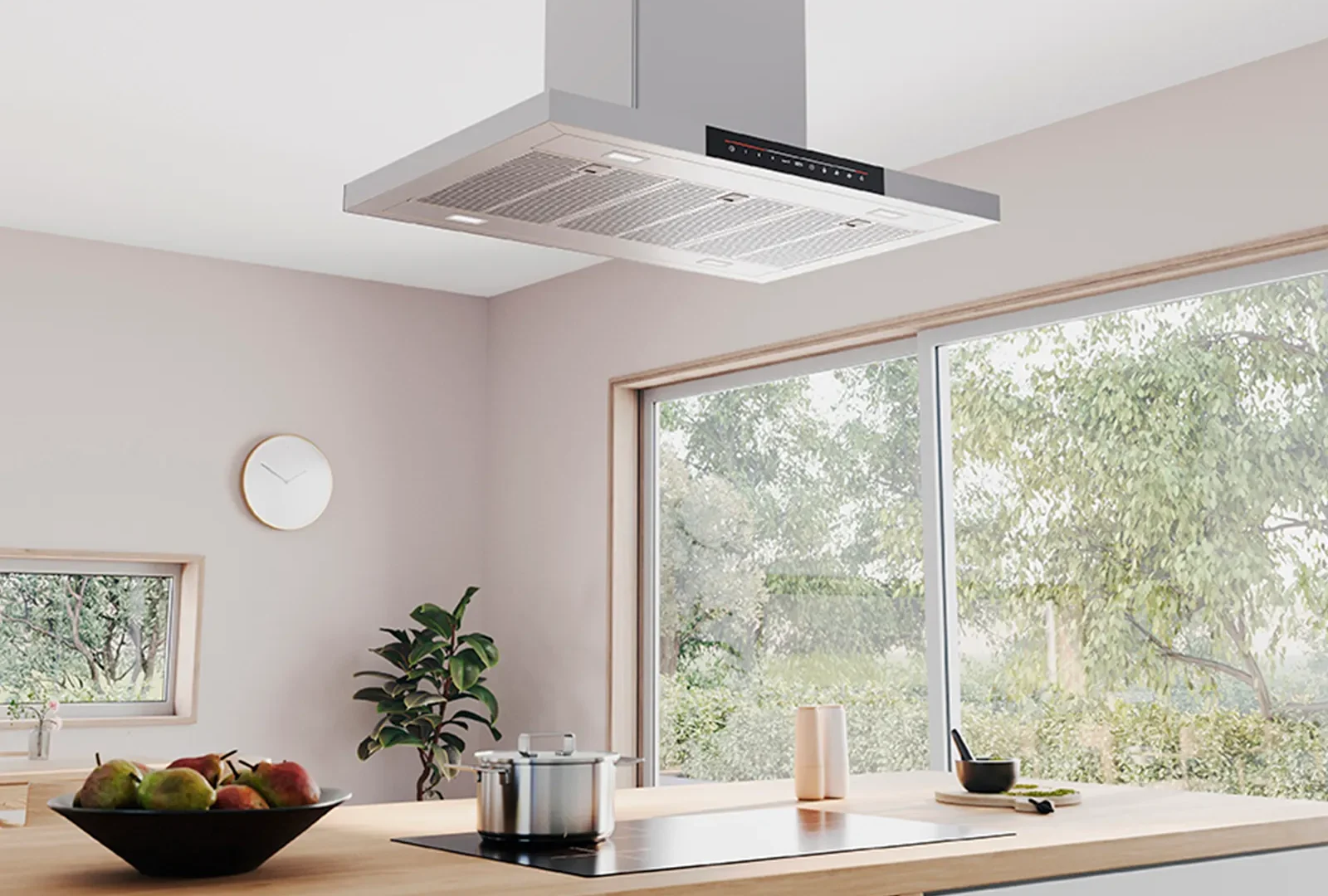
Island Hoods
When the cooktop sits on a kitchen island — increasingly fashionable in open-plan homes in Runda, Muthaiga, and high-end apartments in Riverside — an island hood becomes necessary. These mount to the ceiling above the cooking surface. However, they must work harder than wall hoods because they have no wall to help contain rising fumes.
Expect to invest more both in the unit itself and in the ceiling reinforcement and ductwork required. Airflow ratings of 760 m³/hr or higher are recommended, while premium island hoods can reach 1,200 m³/hr.
Under-Cabinet Hoods (Best for Small Kitchens)
Compact and budget-friendly, under-cabinet hoods slide neatly beneath an existing wall cabinet. They are the best choice for small kitchens and apartments in Kenya where preserving cabinet storage matters and a full chimney hood would dominate the space. Standard sizes are 60cm and 90cm, with depths around 49cm and slim heights of just 15cm. Performance varies widely across this category: entry-level models handle light cooking adequately, while better models from Bosch, Bolesi, Midea, and Newmatic comfortably manage moderate daily use. For a small kitchen, pair a 60cm under-cabinet or slim hood with the highest airflow you can fit, since compact kitchens trap fumes quickly.
Built-In and Telescopic Hoods
These hoods sit concealed inside a custom cabinet, with only the front fascia or a pull-out drawer visible. The result is a minimalist, almost invisible appearance that designers love. Consequently, they are well suited to clients who want the visual focus to remain on the cabinetry rather than the appliance.
Slim and Undermount Hoods
Slim profile hoods suit homeowners who want extraction performance without a dominating visual presence. Undermount chimney slim hoods, such as those from Newmatic, install flush with the underside of a cabinet and often carry long motor warranties.
Downdraft Hoods
A less common option, the downdraft hood rises out of the counter behind the cooktop, capturing fumes downward rather than upward. These hoods help in kitchens where overhead extraction isn’t possible. However, they generally underperform compared to overhead designs because they fight against the natural upward movement of hot air. Some premium units, such as Kaiser’s Empire downdraft induction hob, combine the cooktop and downdraft hood into a single unit.
Ceiling-Mounted (Cassette) Hoods
Set flush into the ceiling above the cooktop, cassette hoods are sleek and unobtrusive. They are typically used in luxury island kitchens and require more sophisticated ducting work above the ceiling slab.
Commercial Canopy Hoods
For restaurants, hotels, schools, hospitals, and institutional kitchens, the residential options above are simply not enough. Commercial canopy hoods are fabricated from grade 304 stainless steel sheet, with framework, supports, and stiffening from galvanized mild steel rectangular hollow sections.
They feature deep grease drainage channels with 20mm drain holes, a plenum box for even airflow distribution, and baffle-type washable stainless steel grease filters. Removable grease collection cups and integrated lighting complete the package. They are sized to the entire cooking line and connected to high-capacity extractor fans and ducting systems. Together, these form part of a complete commercial kitchen ventilation system — the area Spinel Dynamics specialises in for hospitality clients across Kenya.
Commercial Kitchen Hood Configurations
In professional kitchens, commercial hoods fall into three main configurations.
Type I Wall Canopy Hoods
Wall canopy hoods mount against a wall above a cooking line. They capture both grease and smoke, the standard arrangement for most restaurant kitchens, handling frying, grilling, broiling, and char-cooking.
Type I Island Canopy Hoods
Island canopy hoods sit above a cooking line with no wall behind it. You’ll find them in show kitchens, hotel buffet stations, and food courts. They require higher extraction rates than wall canopies because rising fumes can escape from all four sides.
Type II Proximity (Back-Shelf) Hoods
Proximity hoods are smaller and mounted close behind and just above the cooking equipment. They handle steam, heat, and moisture from boilers, steamers, and dishwashers, but not heavy grease-producing equipment. They are useful where ceiling height is limited.
Each type requires a different airflow calculation. Getting that calculation wrong is one of the most common, and most expensive, mistakes in commercial kitchen design.
Major Kitchen Hood Brands in the Kenyan Market
The Kenyan kitchen hood market features a healthy mix of global premium brands, mid-tier international names, and locally fabricated juakali options. Here’s a snapshot of what’s available.
Premium International Brands
Bosch delivers German engineering with features like PerfectAir self-regulating fan speed and AutoStart hood-hob connection, low noise levels, and multi-stage grease and odour filtration. Bosch occupies a premium position in the market.
Kaiser specialises in high-end European-style hoods, including the La Perle Noire TFT Display range and the Empire collection, positioned at the luxury end of the market.
Ariston offers premium European designs with smart controls, low noise levels, multi-speed operation, and washable aluminium grease filters.
Faber is the Italian specialist with compact, powerful models popular in apartment installations.
Strong Mid-Range Players
Newmatic is a strong local player with the largest dedicated kitchen appliance focus in Kenya. Their range includes slim undermount, curved chimney, vertical wall-mount, island, and flagship auto-extending models. Their showrooms are located along Mombasa Road, and they offer free delivery and installation within Nairobi County.
Hisense produces modern, affordable hoods including under-cabinet, pyramid chimney, and built-in cassette models, widely available through Hisense Kenya and its partners.
Haier maintains a strong mid-market presence with 60cm and 90cm professional chimney hoods (with extraction up to 1,600 m³/hr) and complete built-in bundles combining hood, hob, and oven.
Hotpoint is a reliable European brand with a range of chimney hoods marketed through Hotpoint Appliances Kenya.
Budget and Local Options
Bolesi offers affordable Chinese-made hoods widely distributed across Nairobi CBD, including under-cabinet smoke extractors in 60cm and 90cm sizes.
Ramtons is a familiar Kenyan household name offering competitively-priced hoods at entry and mid-range levels.
Mika is a Kenyan-focused brand with energy-efficient hoods designed for local conditions and price points.
Techwin Limited is a local Kenyan manufacturer specialising in food-grade stainless steel commercial kitchen hoods, serving hotels, restaurants, institutions, and food processing facilities.
Juakali / custom fabricated hoods remain extremely popular for commercial applications. Locally-fabricated stainless steel hoods from Industrial Area workshops offer flexibility in sizing, lower cost, and rapid turnaround.
How to Choose the Right Kitchen Hood: Key Specifications Explained
Walking into an appliance showroom in Kilimani or browsing online listings can be overwhelming. Here are the specifications that actually matter.
Airflow (Extraction Rate)
Measured in cubic metres per hour (m³/hr), this is the single most important performance figure. The rule of thumb for residential kitchens is ten air exchanges per hour. For a typical 20 m² Kenyan kitchen with a 2.7 m ceiling, that translates to roughly 540 m³/hr minimum. For serious cooking, however, 700–900 m³/hr is a more comfortable target.
Premium residential hoods can deliver up to 1,600 m³/hr. By contrast, commercial kitchens require dramatically more, often 2,000 to 6,000 m³/hr or higher, calculated based on cooking equipment heat output and grease-producing potential.
Hood Width and Sizing
The hood must be at least as wide as the cooktop. Ideally, it should extend 10–15 cm wider on each side to capture the plume of rising vapour that naturally spreads outward. Standard widths in Kenya are 60cm and 90cm, with 120cm models available for large designer cooktops.
Noise Level
Measured in decibels (dB), a quieter hood makes a real difference in open-plan homes. Anything under 65 dB on the highest speed is acceptable, premium models operate at around 62 dB, and the quietest DC-motor models drop below 55 dB.
Filter Types
Aluminium mesh grease filters are washable and reusable — choose these rather than disposable types. Baffle filters, used in commercial settings, are more efficient at separating grease from air and remain dishwasher-safe. Charcoal carbon filters, by contrast, are only needed in recirculating installations and require replacement every three to six months.
Motor Specifications
DC motors are the most energy-efficient and quietest, with smooth step-less speed control. AC motors, meanwhile, are the workhorse — durable, powerful, slightly louder. However, you should avoid shaded-pole motors in anything other than the most basic installation, as their performance degrades quickly with age. In addition, mid- to high-end hoods often feature dual or triple motor configurations for higher airflow and redundancy.
Construction Material
Grade 304 stainless steel at 0.6–0.9 mm gauge is the standard for both premium residential hoods and all commercial applications. By comparison, painted or powder-coated steel is cheaper but does not survive long in a working kitchen environment. The hairline-brushed stainless finish is attractive but not scratch-proof, so handle it with care.
Control Types
Touch controls, sealed against steam and grease, are the most durable and easiest to clean, and come standard on high-end products. Push-button electronic controls work well but allow steam ingress over time. Mechanical push buttons are simple and durable but basic. Mechanical slider switches, found on the cheapest models, tend to fail within a year or two. In addition, they are difficult to operate with greasy fingers.
Lighting and Smart Features
Most hoods include LED task lighting above the cooktop. Ideally, look for warm or neutral white LEDs at 2W–4W per lamp, bright enough to cook by without glaring. Higher-end models offer sensor-controlled fan speed that adjusts automatically based on detected odours. Other premium features include automatic switch-on linked to the hob, delayed shut-off, timer functions, remote controls, and smartphone integration. In practice, these features are genuinely useful in everyday cooking.
Warranty Considerations
Some brands, notably Newmatic, offer 5-year motor warranties on many models, a strong indicator of build quality. By comparison, most brands offer 1- to 2-year general warranties.
How Much Does a Kitchen Hood Cost in Kenya?
A common question is how much a kitchen hood costs. Rather than a single figure, it helps to think in tiers, because price tracks closely with size, build quality, airflow, and features.
At the entry level sit basic 60cm under-cabinet hoods and juakali-fabricated residential units, suited to occasional cooking in small apartments. The mid-range tier is where most Kenyan family kitchens land. It covers 60cm and 90cm chimney hoods from brands like Hisense, Haier, Mika, Ramtons, and mid-tier Newmatic, delivering strong everyday performance. Premium hoods include Bosch wall hoods, higher-end Newmatic island models, Ariston premium ranges, and complete built-in bundles. At the luxury end sit Kaiser La Perle Noire and Empire models, the Newmatic flagship island hoods, and top-tier German-engineered designer hoods.
Commercial canopy hood systems are quoted per project, because the price depends on size, fabrication detail, fan capacity, ducting requirements, and integration with fire suppression. Crucially, the hood itself is only part of the cost in any installation. Quality ducting, extractor fans, electrical work, make-up air provision, and professional installation can equal or exceed the price of the hood unit, especially in commercial settings. Because every kitchen is different, the accurate figure comes from a site survey and a written quotation, which Spinel Dynamics provides.
Where to Buy Kitchen Hoods in Nairobi and Across Kenya
Kenyan buyers have multiple sourcing options.
Physical Showrooms
Showrooms offer the chance to see and hear the unit before purchase. For example, Newmatic kitchen appliance stores operate along Mombasa Road and at James Gichuru in Nairobi, while Bosch dealers serve customers in Westlands and Kilimani. In addition, Hotpoint outlets are available across major malls, alongside Kaiser stores, dedicated kitchen-supply showrooms, and appliance retailers in Industrial Area and the CBD.
Online Platforms
Online platforms like Jumia Kenya and Jiji Kenya list hundreds of models from vetted sellers, making it easy to compare styles and specifications before buying.
Specialist HVAC Contractors
Specialist HVAC contractors like Spinel Dynamics Group source hoods directly through manufacturer channels and handle the full design, supply, and installation process. This is the right route for serious residential projects, commercial installations, and any application involving ducted ventilation.
Kitchen Hood Installation in Kenya: Why Professional Fitting Matters
A kitchen hood is only as good as its installation. Several installation factors determine whether your hood performs at rated capacity or disappoints for years.
Correct Mounting Height
Mounting height is critical. Hoods should sit 65–75 cm above electric or induction cooktops and 75–85 cm above gas cooktops. Mount too high and capture efficiency drops sharply; conversely, mount too low and you create a fire risk while impeding cooking.
Proper Duct Sizing and Routing
Duct sizing and routing make or break performance. Every elbow, every undersized section, and every excessive length of ducting cuts extraction performance, sometimes drastically. A hood rated at 800 m³/hr can deliver less than half that figure if connected to poorly designed ductwork.
Spinel Dynamics designs duct runs to be as short and straight as possible, sizes them correctly for the hood’s airflow, and uses rigid round galvanised ducting wherever feasible. By contrast, flexible corrugated hose creates significant friction losses, so we avoid it. Standard residential outlet sizes are 120mm and 150mm diameter.
Make-Up Air Provision
Make-up air provision is essential in commercial kitchens and increasingly important in tightly-sealed modern residential builds. A hood pulling 600 m³/hr out of a kitchen will not perform without an equivalent path for fresh air to enter the space. Otherwise, negative pressure will choke the fan, slam doors, and produce whistling at door gaps. Proper kitchen ventilation design balances extraction with controlled make-up air.
Fire Safety Compliance
Fire safety matters above all in commercial installations. First, commercial hoods in Kenya must meet KEBS standards and integrate with fire suppression systems where required. In addition, ducting must be sealed, insulated where it passes through fire-rated walls, and equipped with access panels for cleaning. Finally, installations must comply with NCA, public health, and county fire regulations.
Electrical Considerations
Power consumption ranges from 100W on slim recirculating units to 600W or more on high-performance ducted models. Commercial extractor fans may require three-phase power depending on motor size and ducting length. As a turnkey service, Spinel Dynamics handles all electrical integration during installation.
Kitchen Hood Maintenance: Keeping Your Hood Working at Peak Performance
The most expensive hood on the market will fail to perform without proper maintenance. Grease accumulation remains the enemy of every extractor.
Residential Maintenance Schedule
For residential hoods, wash the aluminium grease filters every two weeks in hot soapy water or the dishwasher. Wipe down the hood body weekly with a non-abrasive stainless steel cleaner, and avoid steel wool and abrasive pads that scratch the brushed finish. Replace charcoal filters every three to six months in recirculating installations. Additionally, have the unit professionally inspected annually, particularly the motor mounts, fan blades, and electrical connections.
Commercial Maintenance Schedule
For commercial hoods, the maintenance schedule is far more demanding. For instance, baffle filters should be cleaned daily or every shift, depending on cooking volume. Meanwhile, the hood body, plenum, and grease cups need weekly cleaning.
The full duct system requires professional degreasing every three to six months. This is a critical fire prevention measure, not a cosmetic exercise. Indeed, most fatal commercial kitchen fires in East Africa originate in greasy ductwork that has gone too long without cleaning. Therefore, Spinel Dynamics offers scheduled maintenance contracts for commercial kitchen ventilation systems across Kenya, keeping your hood compliant, your insurance valid, and your kitchen safe.
Common Kitchen Hood Mistakes to Avoid
Here are the mistakes we see most often when reviewing existing installations.
Sizing and Selection Errors
Many customers choose a hood that is too small for the kitchen volume or too narrow for the cooktop. Equally common is installing a powerful hood with no make-up air provision, then wondering why it whistles and underperforms.
Installation Shortcuts
Running long, twisted flexible ducting where a short rigid run would have delivered double the extraction is a frequent issue. Likewise, mounting the hood too high above the cooktop happens often because the manual was not consulted.
Maintenance Neglect
Skipping the charcoal filter replacement schedule leads to complaints about smells. Some buyers also choose recirculating mode when ducted operation was feasible. Buying the cheapest available hood often means replacement within eighteen months when the motor burns out or the slider switch fails. Most expensively, in commercial settings operators skip professional duct cleaning until grease fire risk becomes urgent. Every one of these mistakes is preventable with the right partner from the start.
Why Choose Spinel Dynamics for Your Kitchen Hood Project
Our Expertise
Spinel Dynamics Group is Kenya’s leading HVAC company. Our expertise runs deep across air conditioning installation, cold room construction, mechanical ventilation, extractor fans, commercial refrigeration, and VRF/VRV systems. As authorised dealers for Daikin, Carrier, Samsung, LG, Toshiba, Midea, and Panasonic, we bring serious engineering rigour to every kitchen hood project.
Our Turnkey Service
Our team handles every stage of a kitchen hood project under one roof. This includes site survey, airflow calculation, hood specification, ducting design and fabrication, extractor fan sizing, electrical integration, installation, commissioning, and ongoing maintenance. Furthermore, we work with homeowners, architects, interior designers, kitchen designers, hospitality groups, schools, hospitals, and food processors across Kenya.
Our Integration Advantage
What sets us apart is integration. A kitchen hood doesn’t exist in isolation: it interacts with your building’s mechanical ventilation, make-up air strategy, fire safety system, and increasingly your air conditioning. Because Spinel Dynamics designs and installs all of these systems, we make sure your hood works with the rest of your building rather than against it. We also supply, install, and service every category of kitchen hood, from compact residential under-cabinet units to massive industrial canopy systems. Best of all, every installation comes with full warranty backing and locally-available technical support.
Frequently Asked Questions
Which brand is best for a kitchen hood in Kenya?
There’s no single best brand — it depends on your budget and needs. For premium German engineering and quiet operation, Bosch leads. Newmatic, meanwhile, offers the strongest local range, warranties, and after-sales support. Affordable, reliable everyday hoods come from Hisense, Haier, Mika, and Ramtons. At the luxury end, Kaiser and Ariston stand out, while commercial kitchens rely on custom-fabricated grade 304 stainless steel hoods.
Which type of kitchen hood is best?
For most Kenyan homes, a wall-mounted chimney hood offers the best balance of performance and looks. Island hoods are necessary when the cooktop sits on an island. Under-cabinet and slim hoods are best for small kitchens, built-in and telescopic hoods suit minimalist designs, and commercial canopy hoods are essential for restaurants and hotels. The best type is the one that matches your cooktop position, cooking volume, and kitchen layout — and a ducted version always outperforms a recirculating one.
How much is a Mika kitchen hood in Kenya?
Mika is a Kenyan-focused brand positioned in the affordable, energy-efficient bracket, so its hoods sit toward the entry and mid-range end of the market. Exact pricing varies by model, size, and retailer, so check current listings at authorised Mika dealers or request a quotation. If you’d like, Spinel Dynamics can advise on whether a Mika model or an alternative best suits your kitchen.
What are the disadvantages of kitchen hoods?
The main drawbacks are noise at high speed (worse on cheap motors), the cost and complexity of ducted installation, and ongoing filter maintenance. There is also the visual bulk of larger chimney and canopy styles, plus the need for make-up air in tightly-sealed kitchens. Fortunately, all are manageable by choosing the right type and airflow and having the hood installed professionally.
Do all kitchen hoods need to be vented outside?
No. Recirculating hoods filter air through grease and charcoal filters and return it to the kitchen. However, ducted operation is significantly more effective at removing heat, moisture, and odours, and it remains mandatory for gas cooktops in commercial settings.
What size kitchen hood do I need?
The hood should be at least as wide as your cooktop, ideally 10–15 cm wider on each side. For airflow, aim for ten air changes per hour for your kitchen volume. In practice, that means roughly 540 m³/hr for a typical 20 m² kitchen, with 700–900 m³/hr preferred for serious cooking.
What is the difference between a ducted and a recirculating kitchen hood?
A ducted hood expels air outside through ductwork, removing heat, moisture, smoke, and odours completely. A recirculating hood filters air and returns it to the room, which is cheaper and easier to install but less effective and requires regular charcoal filter changes. Ducted is the better choice wherever the building allows it.
How much does a kitchen hood cost in Kenya?
It depends on size, build quality, airflow, features, and whether it’s residential or commercial. Entry-level under-cabinet hoods are the most affordable, mid-range chimney hoods suit most homes, and luxury and commercial canopy systems sit at the top. Remember that ducting, fans, electrical work, and installation add to the cost. Spinel Dynamics provides a transparent, itemised quotation after a site survey.
How long does commercial hood installation take?
For a typical restaurant kitchen, Spinel Dynamics completes installation within 2–7 days, depending on complexity, ducting requirements, and integration with existing systems.
Can you fabricate custom-sized hoods?
Yes. For commercial applications, we fabricate stainless steel canopy hoods to any size required, each complete with grease channels, baffle filters, plenum boxes, and integrated lighting.
How often should a kitchen hood be cleaned?
Wash residential grease filters every two weeks and replace charcoal filters every three to six months. Commercial baffle filters need cleaning daily or per shift, and the full duct system should be professionally degreased every three to six months as a fire-prevention measure.
Do you service kitchen hoods outside Nairobi?
Yes. Spinel Dynamics serves Mombasa, Kisumu, Nakuru, Eldoret, Naivasha, Nyeri, Thika, and Machakos, and we deploy projects to Uganda, Tanzania, and Rwanda on request.
Ready to Specify the Right Kitchen Hood?
Whether you are building a dream home in Karen, refurbishing a restaurant kitchen in Westlands, fitting out a new hotel in Diani, or designing an industrial food production line in Athi River, the right kitchen hood pays for itself many times over. The benefits include better air quality, longer equipment life, improved fire safety, and greater energy efficiency.
Talk to the team at Spinel Dynamics Group for a site visit, a fully-engineered proposal, and a quotation tailored to your kitchen.
Spinel Dynamics Group Aqua Plaza, First Floor, Murang’a Road, Nairobi Phone: +254 714 821 020 Email: info@spineldynamics.com Mon–Fri: 8:00 AM – 6:00 PM | Sat: 9:00 AM – 2:00 PM
Quick Links: Home · About Us · Services · Products · Blog · Contact Us
Our Services: Air Conditioning · Mechanical Ventilation · Cold Rooms · Split Aircons · VRF/VRV Systems · Extractor Fans