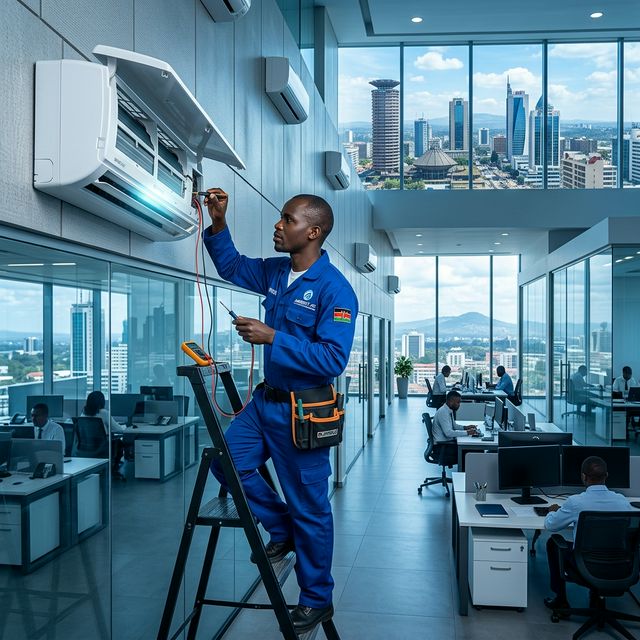
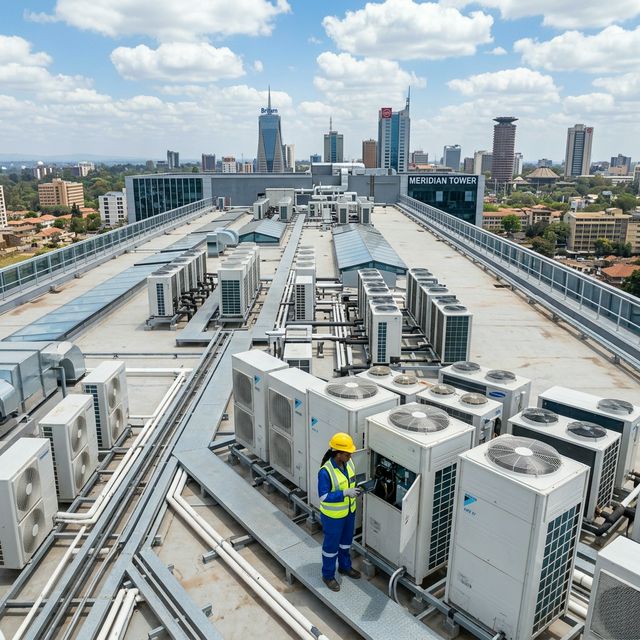
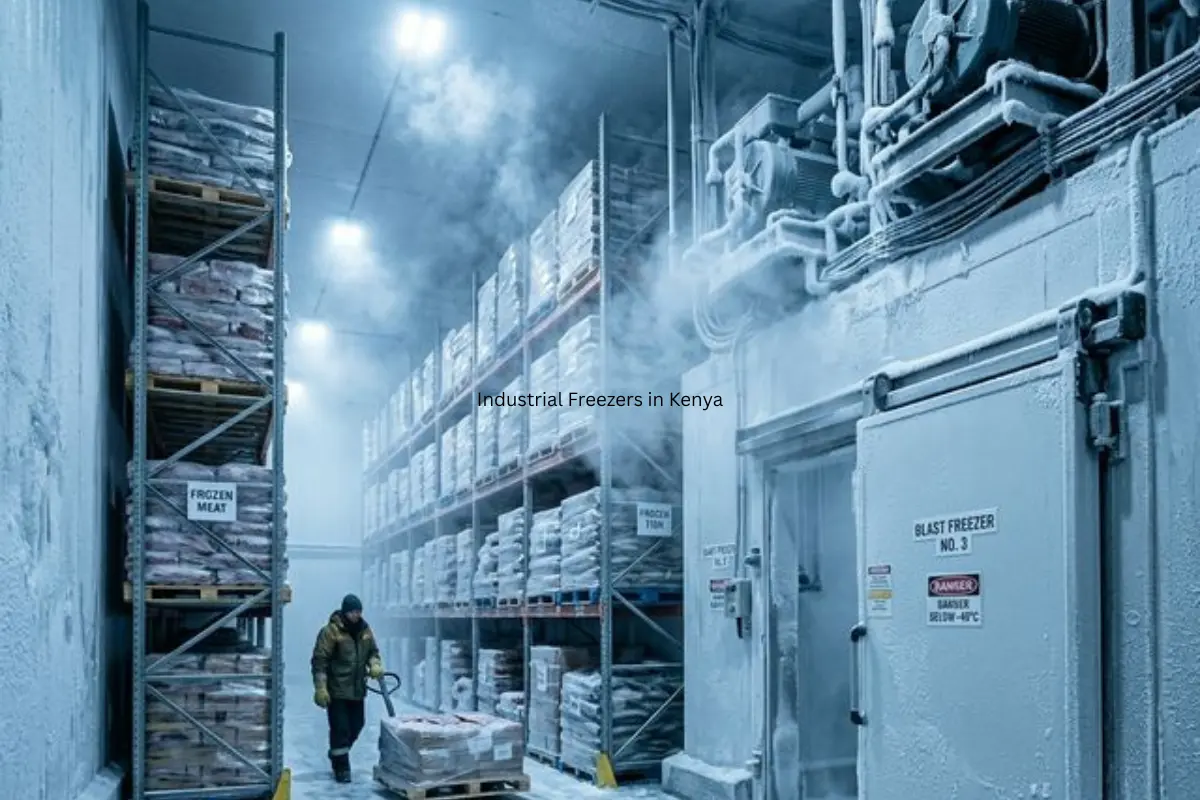
Looking for industrial freezers in Kenya? Get expert design, supply, installation and 24/7 repair from Spinel Dynamics Group. Free site visit & quote.
By Spinel Dynamics Group | Kenya’s Leading Industrial Refrigeration & Cold Storage Engineers
Why Industrial Freezers Power Kenya’s Frozen Economy
Behind every frozen chicken on a supermarket shelf sits one thing — an industrial freezer. Similarly, every kilo of exported fish flown out of Kilifi depends on the same equipment. Furthermore, every tub of ice cream in a Nairobi parlour and every batch of frozen vegetables shipped to the EU relies on industrial-grade freezing. Without reliable, properly engineered industrial freezers, Kenya’s growing meat, fish, dairy, horticulture, pharmaceutical and food processing industries would simply not work.
However, industrial freezers are nothing like the chest freezer in your kitchen. Instead, they are heavy-duty, purpose-built refrigeration systems. Moreover, they handle large product volumes, achieve very low temperatures, run 24/7 for years, and meet strict food safety, export and regulatory requirements. As a result, the wrong industrial freezer costs you spoiled stock, failed export consignments, NEMA notices, KEBS rejections and crippling electricity bills. Meanwhile, the right one quietly pays for itself many times over.
At Spinel Dynamics Group, we have spent over a decade designing, supplying, installing and maintaining industrial freezers in Kenya. For example, we have built fish blast freezers in Mombasa and Lamu. In addition, we have delivered frozen meat warehouses for processors in Athi River. Furthermore, we have installed ice cream hardening rooms for major dairies, vegetable IQF tunnels for export farms in Naivasha, and pharmaceutical -25°C freezers for biotech companies in Nairobi. This complete guide brings together everything you need to know before buying, building or upgrading an industrial freezer in Kenya.
What Is an Industrial Freezer?
An industrial freezer is a large-scale, heavy-duty refrigeration system. Specifically, it freezes and stores products at temperatures between -18°C and -45°C. Moreover, it handles capacities and duty cycles far beyond what commercial or domestic freezers can manage.
The key features of industrial freezers include high freezing capacity. Notably, this is measured in kilograms per hour or tonnes per day rather than just total storage volume. In addition, they offer continuous duty operation, since they are designed for 24/7 use. Furthermore, they use industrial-grade components such as semi-hermetic or screw compressors, heavy-duty evaporators, and robust controls. Beyond that, they reach low temperature ranges — down to -40°C for blast freezers and -45°C for ultra-low applications. Finally, they meet compliance standards like HACCP, EU export, KEBS, and NEMA.
In simple terms, a domestic freezer is a bicycle. By contrast, a commercial freezer is a delivery van. Likewise, an industrial freezer is a heavy goods truck. Therefore, these are completely different categories of equipment for completely different work.
Industrial Freezers vs Commercial Freezers vs Cold Rooms
These terms overlap in the Kenyan market. Often, they are used loosely. Here’s how we use them at Spinel Dynamics Group.
Domestic freezers — chest or upright units up to ~500 litres, suitable for homes and very small businesses.
Commercial freezers — larger upright or chest units, glass-door display freezers, ice cream display freezers, and prep freezers. Typically, they range from 200 to 2,000 litres. Generally, they suit restaurants, small shops, butcheries, and cafés.
Industrial freezers — walk-in freezer rooms, blast freezers, IQF tunnels, plate freezers, spiral freezers, and industrial cold stores. Capacities range from several cubic metres to thousands of cubic metres. Consequently, they suit food processors, exporters, pharmaceutical companies, large supermarkets and institutions.
Where commercial and industrial freezers meet, we sometimes call the equipment “heavy-commercial”. As such, our team helps clients position correctly between commercial and industrial specifications based on actual throughput requirements.
Types of Industrial Freezers Available in Kenya
Different freezing applications need different freezer types. Therefore, choosing the right type is the foundation of any successful industrial cold project.
1. Walk-In Freezer Rooms (-18°C to -25°C)
Walk-in freezer rooms are the workhorses of industrial frozen storage. Essentially, they are insulated rooms built from prefabricated polyurethane (PU) panels. In addition, they are fitted with industrial refrigeration units. As a result, they suit long-term storage of frozen meat, fish, poultry, ice cream, vegetables and ready meals.
Typically, walk-in freezers in Kenya range from 10 m³ for small butcheries and fish traders, to 1,000 m³ or more for major food processors. Usually, the temperature stays at -18°C to -22°C for standard frozen storage. However, -25°C is used for harder freezing of products like fish and ice cream.
We design and build walk-in freezers across Kenya. For instance, we have delivered a 12 m³ freezer for a fish trader in Likoni. Similarly, we have built a 600 m³ logistics freezer at JKIA cold chain terminals.
2. Blast Freezers (-30°C to -45°C)
Blast freezers rapidly reduce the core temperature of products. Specifically, they bring food from ambient or chilled state down to deep-frozen (-18°C core temperature) in 4 hours or less. As a result, this is fundamentally different from a walk-in storage freezer. In short, blast freezers freeze food, while walk-ins keep it frozen.
Rapid freezing matters because slow freezing forms large ice crystals. Consequently, these crystals rupture cell walls, ruining texture, flavour and nutrition. By contrast, fast freezing forms tiny ice crystals. As a result, the product remains virtually unchanged when thawed. Therefore, this is the difference between premium-quality frozen fish that thaws to firm fillets, and poor-quality frozen fish that thaws to mushy flesh.
Blast freezers are essential for several Kenyan industries. For instance, fish processors and exporters along the coast and Lake Victoria depend on them. Likewise, meat exporters supplying Middle East and African markets need them. Additionally, ice cream and dessert manufacturers use them for rapid hardening. Beyond that, vegetable and fruit processors rely on them for export freezing. Moreover, ready-meal manufacturers and pharmaceutical operations use them daily.
Typically, blast freezer capacities are measured in kilograms per cycle. For small units, this means 50 kg per cycle. However, industrial-scale operations may handle 5,000 kg per cycle. Generally, cycle times run 4 to 8 hours depending on product type and starting temperature.
3. Spiral Freezers (Continuous IQF)
Spiral freezers are continuous-flow industrial freezers. Mainly, they are used in high-volume food processing. Specifically, product travels on a stainless steel mesh belt that spirals upward through a refrigerated enclosure at -35°C to -40°C. As a result, it exits fully frozen after 15 to 60 minutes depending on product size.
Several industries use spiral freezers in Kenya. For example, industrial fish processors, poultry producers, ready-meal manufacturers, ice cream novelty producers and vegetable processors rely on them daily. Notably, they handle throughputs of 500 kg/hr to 5,000 kg/hr.
Our team designs and installs spiral freezer systems for major food processors in Kenya. In particular, we work with leading European manufacturers including GEA, JBT, Marel and Linde.
4. IQF Tunnel Freezers (Individual Quick Freezing)
IQF (Individual Quick Freezing) tunnel freezers use either fluidised bed or impingement air technology. Specifically, they rapidly freeze small individual product pieces such as peas, beans, sweetcorn, prawns, berries, diced vegetables, fish fillets, or chicken nuggets. As a result, the pieces do not stick together.
Generally, product travels through a tunnel where high-velocity cold air at -35°C to -40°C blasts it from all sides. Consequently, pieces exit individually frozen, free-flowing, and ready for packing.
IQF technology is critical for Kenya’s growing horticultural export industry. Moreover, it is essential for vegetable processing, prawn farming and modern food production. Therefore, we work with leading IQF manufacturers including Octofrost, Frigoscandia, JBT and Linde to deliver complete IQF lines.
5. Plate Freezers (Contact Freezers)
Plate freezers freeze product through direct contact with refrigerated metal plates at -35°C to -40°C. Typically, product is packed in boxes or trays for this process. During operation, the plates close mechanically on the product. As a result, very fast heat transfer occurs through both top and bottom surfaces.
Generally, plate freezers are used for fish blocks, fish fillets, prawns, and meat blocks. Notably, they achieve faster freezing than air-blast systems for the same product. Moreover, they consume less energy per kg frozen.
Therefore, plate freezers are essential equipment at large fish processing plants along the Kenyan coast, in Kisumu and at Lake Naivasha tilapia operations.
6. Cryogenic Freezers (Liquid Nitrogen and CO₂)
Cryogenic freezers use liquid nitrogen at -196°C or liquid CO₂ at -78°C as the freezing medium. Consequently, they achieve the fastest possible freezing rates. Generally, they suit premium-quality fish, prawns, premium ready meals and pharmaceutical applications. In short, they are used where ultimate product quality justifies the higher operating cost.
Where the application justifies it, we design and integrate cryogenic freezing solutions.
7. Ice Cream Hardening Rooms (-30°C to -40°C)
Ice cream hardening rooms are specialised low-temperature rooms. Specifically, they are used after the batch freezer. Their purpose is to drop ice cream from -8°C (the temperature at which it exits the batch freezer) down to -25°C or lower for storage and distribution. Typically, they are built as small dedicated rooms within a larger ice cream production facility.
Over the years, we have built hardening rooms for several major and emerging Kenyan ice cream producers.
8. Pharmaceutical Ultra-Low Freezers (-30°C, -60°C, -80°C)
Pharmaceutical, biotech and research applications often require ultra-low temperature freezers. Notably, these go far below food-industry norms. Therefore, we supply and install -30°C, -60°C and -80°C freezer rooms for vaccines, biological samples, plasma and reagents. In addition, we build large-scale ultra-low pharmaceutical cold rooms with validation, mapping and continuous monitoring.
9. Mortuary and Forensic Freezers (-20°C)
Hospitals, county morgues and forensic facilities sometimes need ultra-low body storage at -20°C. Typically, this is in addition to standard mortuary chillers at 2–4°C. Consequently, we design and supply these specialised installations.
10. Industrial Blast Coolers (above 0°C)
Although not technically freezers, blast coolers belong to the same equipment family. Their purpose is to rapidly chill hot products (cooked meals, freshly cooked meat, dairy products) from cooking temperatures down to 3°C in 90 minutes. As a result, they are essential for central kitchens, food production lines and meat cooking operations.
How Industrial Freezers Are Built: Inside the Equipment
A professional industrial freezer is far more than just a cold box. Therefore, here are the major systems that make it work. Moreover, here are the components that decide whether it lasts 4 years or 20.
1. Insulated Panels
Walk-in freezers and blast freezers are constructed from prefabricated sandwich panels. Specifically, they use polyurethane (PU) foam cores between two metal skins.
For freezer applications, panel thickness must be substantial. Generally, we use 100 mm minimum for -18°C rooms. Furthermore, blast freezers at -35°C and below need 120–150 mm panels. Additionally, ultra-low temperature rooms below -50°C may need up to 200 mm. Importantly, PU foam density should be 40–42 kg/m³ for proper performance.
Typically, the skins are pre-painted galvanised steel for internal use. However, food-grade stainless steel (304 or 316) skins are specified where direct food contact occurs. Likewise, stainless steel is used where corrosion is a concern. For coastal locations and fish processing applications, we use SS 316 throughout.
Beware of cheap thinner panels marketed as “freezer panels” at 60–80 mm thickness. While they may look identical when new, they lose insulation value within 3–5 years. Moreover, they allow cold bridges, develop condensation problems, and dramatically increase running costs. Therefore, we specify only proper freezer-grade panels.
2. Industrial Refrigeration Compressors
The compressor is the heart of an industrial freezer system. For freezer applications, we typically use the following options.
First, Bitzer semi-hermetic reciprocating compressors (Germany) — the global benchmark for industrial refrigeration. Specifically, they excel at low evaporating temperatures. Moreover, they are fully serviceable and extremely durable. As a result, this is our preferred choice for most industrial freezer projects in Kenya.
Second, Bitzer and Frascold screw compressors (Germany/Italy) — used in larger installations. Typically, this means 50+ kW refrigeration capacity, where reciprocating units would be impractical.
Third, Copeland semi-hermetic and scroll compressors (USA/Emerson) — strong alternatives. Notably, they suit medium-capacity installations and pharmaceutical applications.
Finally, Dorin transcritical CO₂ compressors (Italy) — used in modern low-GWP industrial freezer designs. Particularly, they suit projects where regulatory compliance and long-term energy efficiency justify the higher capital cost.
For low-temperature applications (-35°C and below), we typically use two-stage compression or cascade systems. In these designs, two refrigeration circuits work in series. Specifically, a high-stage circuit cools the low-stage condenser. As a result, this dramatically improves efficiency and component life at low temperatures.
3. Evaporators and Condensers
For premium projects, we use industrial-grade evaporators from Güntner (Germany), LU-VE (Italy), Kelvion (Germany) and ECO (Italy). Additionally, we offer selected Chinese alternatives for budget projects. Notably, evaporators in freezer applications need wider fin spacing (8–10 mm typical) to prevent ice clogging. Moreover, they require robust electric defrost systems for periodic ice removal.
Condensers come in three main types. First, air-cooled units are most common in Kenya. Second, water-cooled units suit projects where cooling water is available. Third, evaporative condensers are most efficient in dry climates like Nairobi, though they involve water consumption considerations.
4. Refrigerants
Industrial freezer refrigerant selection matters significantly. Below are the common refrigerants we use in Kenya.
R404A — historically the most common industrial refrigerant. However, it is being phased down under the Kigali Amendment. Currently, we still use it for retrofit and like-for-like replacement. Nevertheless, we specify alternatives for new installations.
R507 — similar performance to R404A. Generally, it is used in some industrial freezer applications.
R448A and R449A — lower-GWP HFO/HFC blends. Specifically, they are used as drop-in replacements for R404A in new installations.
R744 (CO₂) — natural, zero-ODP, very low GWP refrigerant. Particularly, it is used in modern transcritical industrial systems for supermarkets and large cold storage facilities. Notably, it is increasingly popular for new builds.
R717 (Ammonia) — natural refrigerant with excellent thermodynamic properties. Usually, it is used in large industrial cold storage facilities where safety distances and trained personnel are available. Commonly, it is found in international fish processing and large meat plants.
R290 (Propane) — natural, very low GWP. Generally, it is used in smaller-capacity industrial freezer systems where charge limits allow.
Refrigerant choice is a major engineering decision. Specifically, it balances capital cost, energy efficiency, regulatory compliance, safety and long-term availability. Therefore, we help clients navigate this for every project.
5. Industrial Doors
Freezer doors are critical and often where cheap installations fail first. As a result, we specify heavy-duty doors with the following features. First, full PU insulation matching panel thickness. Second, magnetic gaskets that seal positively. Third, internal safety releases — mandatory, since no one should ever be trapped in a freezer. Fourth, electric door frame heaters to prevent ice build-up. Fifth, robust hinges rated for high-frequency commercial use. Finally, viewing windows where appropriate.
For high-traffic operations, we install rapid-roll doors or air curtains. Specifically, PVC strip curtains plus high-speed roller doors minimise infiltration during loading.
6. Floor Construction
Freezer floors are a major engineering element. For blast freezers and any freezer operating below -25°C, we install underfloor heating cables and proper underfloor insulation. The reason is to prevent frost heave — where moisture in the ground beneath the freezer freezes and lifts the floor. Eventually, this destroys the structure.
For walk-in storage freezers operating at -18°C to -22°C, we typically use insulated PU floor panels. Additionally, we apply non-slip stainless steel or fibreglass-reinforced finishes. Furthermore, we include screed ramps for forklift access.
7. Controls, Monitoring and Alarms
Modern industrial freezers in Kenya should include several control features. First, digital controllers from Dixell, Carel, Eliwell, or Danfoss for precise temperature and defrost management. Second, high-temperature alarms with audible alert and SMS/email notification. Third, continuous temperature logging for traceability and compliance. Finally, remote monitoring via cellular or internet connection.
For HACCP compliance and export operations, full-traceability monitoring systems are essential. Therefore, we supply and install these as integrated components of the freezer system.
Industrial Freezer Sizing: Getting It Right
Correct sizing is where most failed industrial freezer installations actually fail. Sadly, this happens long before the equipment ever has a chance to break.
Storage Freezer Sizing
For walk-in storage freezers, sizing is based on product storage volume plus operational allowances. Specifically, we calculate the following factors. First, pallet positions needed (typically 1 pallet = 1 m² floor space + aisles). Second, product weight per pallet (varies by product). Third, turnover rate (how fast stock cycles through). Fourth, forklift aisle space (typically 3 to 4 metres for industrial forklifts). Fifth, evaporator clearance (typically 1 metre clear of ceiling). Sixth, door swing and approach areas. Finally, growth allowance (we typically add 20–30% spare capacity).
Blast Freezer Sizing
Blast freezers are sized completely differently. Instead of storage volume, sizing is based on freezing throughput. Therefore, we calculate the following inputs. First, kilograms of product to freeze per shift. Second, product type and starting temperature. Third, target core temperature and time available. Fourth, refrigeration capacity needed at low evaporating temperature. Finally, air circulation rates for proper heat transfer.
For example, a typical mid-size fish blast freezer might handle 500 kg of fillets per 6-hour cycle. Consequently, it would require approximately 25–30 kW of refrigeration capacity at -40°C evaporating temperature.
Refrigeration Capacity Calculation
The refrigeration unit must handle the total heat load. For freezer applications, we calculate heat from six sources. First, conduction through walls, ceiling and floor (depends on panel thickness, outdoor temperature, sun load). Second, product load (mass × specific heat × temperature drop). Notably, this is often the dominant load for blast freezers. Third, air infiltration through doors during loading. Fourth, people working inside. Fifth, lights, evaporator fans and other electrical equipment. Finally, respiration heat from any non-frozen produce in cool storage.
In total, the heat load determines the compressor and evaporator size. Generally, this is measured in kilowatts (kW), tons of refrigeration (TR), or BTU/hr.
Sizing is engineering, not guesswork. Unfortunately, cheap suppliers in Kenya commonly under-size by 20–40% to win price-sensitive tenders. As a result, they deliver equipment that can’t hold setpoint on hot days. Moreover, the equipment runs constantly, fails early, and burns excess electricity for its entire short life.
Industrial Freezer Prices in Kenya (2026)
Industrial freezer pricing depends on several factors. Specifically, these include capacity, temperature range, refrigeration system specification, brand choice, panel thickness, doors, controls, and installation complexity. Below are realistic 2026 price ranges from Spinel Dynamics Group, in Kenya Shillings (KSh) and excluding VAT.
| Industrial Freezer Type | Typical Application | Indicative Price Range (KSh) |
|---|---|---|
| Small walk-in freezer (10 m³, -22°C) | Butchery, fish trader | 750,000 – 1,400,000 |
| Medium walk-in freezer (25 m³, -22°C) | Restaurant chain, distributor | 1,400,000 – 2,500,000 |
| Large walk-in freezer (60 m³, -22°C) | Supermarket, food processor | 2,500,000 – 4,800,000 |
| Very large freezer (150 m³, -22°C) | Cold storage warehouse | 4,800,000 – 9,500,000 |
| Industrial cold store (500+ m³) | Logistics, major processor | 12,000,000 – 50,000,000+ |
| Small blast freezer (250 kg/cycle, -40°C) | Small fish/meat processor | 1,800,000 – 3,500,000 |
| Medium blast freezer (1,000 kg/cycle, -40°C) | Fish/meat exporter | 3,500,000 – 7,500,000 |
| Large blast freezer (2,500+ kg/cycle, -40°C) | Industrial processor | 7,500,000 – 18,000,000 |
| Plate freezer system (small) | Fish processor | 4,500,000 – 8,500,000 |
| Plate freezer system (large) | Major fish processor | 8,500,000 – 25,000,000 |
| Spiral freezer | Food processor | 15,000,000 – 60,000,000+ |
| IQF tunnel system | Vegetable/seafood exporter | 18,000,000 – 80,000,000+ |
| Ice cream hardening room (15 m³) | Ice cream producer | 2,800,000 – 5,500,000 |
| Pharmaceutical freezer room (-30°C, 20 m³) | Pharma, biotech | 3,500,000 – 7,000,000 |
| Ultra-low pharma freezer (-80°C, small) | Vaccines, biologics | 4,500,000 – 12,000,000 |
These prices include design engineering, panels, refrigeration plant supply and installation, electrical connection, refrigerant charge, commissioning and a one-year workmanship warranty. However, for coastal installations using SS 316 stainless steel, expect approximately 15–25% additional cost.
Request a free site visit and detailed quotation for your specific project.
Industries That Rely on Industrial Freezers in Kenya
Industrial freezers underpin some of Kenya’s most economically important industries.
Fish, Seafood and Aquaculture
The Kenyan coast (Mombasa, Kilifi, Malindi, Lamu, Diani) produces significant fish volumes. Similarly, Lake Victoria (Kisumu, Homa Bay) generates substantial output. Notably, much of it is destined for export. Therefore, industrial blast freezers and plate freezers are essential for export-quality processing. Meanwhile, walk-in storage freezers hold inventory between processing and shipment. Additionally, tilapia and aquaculture operations at Lake Naivasha depend on industrial freezing.
Meat and Poultry Processing
Kenya’s growing meat industry requires industrial-scale freezer capacity. Specifically, beef, goat, chicken, and lamb processors need both domestic supply and growing export to the Middle East and Africa. As a result, major processors operate blast freezers for rapid freezing of cuts and offal. Furthermore, they use large walk-in cold storage for inventory.
Dairy and Ice Cream
Major dairy processors operate industrial ice cream hardening rooms, dairy cold storage and frozen product holding. Over the years, we have designed and installed equipment for several established and emerging Kenyan dairy operations.
Horticulture and Vegetable Processing
Kenya’s flower export industry uses cold storage rather than freezers. However, a growing vegetable export segment increasingly relies on IQF tunnel freezers and blast freezers. Specifically, these produce frozen mixed vegetables, green beans, sweetcorn and other products for European supermarket supply chains.
Pharmaceutical and Biotech
Several institutions operate ultra-low freezers. Specifically, hospitals, research institutions, vaccine distributors and pharmaceutical companies use -20°C, -30°C and -80°C freezers. Generally, these store biologics, vaccines, samples, reagents and pharmaceutical inventory. Importantly, WHO and GDP compliance requires validated, mapped, continuously monitored installations.
Food Manufacturing and Processing
Many food manufacturers depend on integrated freezer systems. For example, ready-meal manufacturers, sausage and processed meat producers, baked goods companies, prepared-food caterers and confectionery makers all use blast freezers plus large walk-in storage.
Cold Storage and Logistics
Several logistics operators run large-scale freezer warehouses. Specifically, independent cold storage operators, freight forwarders, airfreight cold chain operators (especially serving JKIA) and 3PL providers use industrial freezers. Generally, they store frozen export and domestic product short or medium-term.
Supermarket Distribution Centres
Major supermarket chains operate central distribution warehouses. Typically, these include large industrial freezers serving multiple branches.
Hospitality
Larger hotels often install industrial-grade freezer facilities. Particularly, those with substantial banqueting operations and resort properties with multiple food outlets need capacity far beyond typical commercial freezers.
Government and Institutional
Several government bodies use industrial-grade frozen storage. Specifically, KMC, KEMSA, county hospitals, military catering operations and disaster preparedness storage all rely on this equipment.
Refrigerant and Environmental Compliance
Kenya has ratified the Kigali Amendment to the Montreal Protocol. As a result, the country has committed to phase down high-GWP hydrofluorocarbon (HFC) refrigerants. Progressively, the National Environment Management Authority (NEMA), Kenya Bureau of Standards (KEBS) and the Department of Occupational Safety and Health Services (DOSHS) are enforcing this.
For owners of existing industrial freezers running R22, urgent action is needed. Notably, R22 is being phased out. Furthermore, supply is increasingly restricted and expensive. Therefore, retrofit or replacement planning should be in progress now.
For owners of R404A systems, supply continues but at rising cost. However, new build is increasingly moving to lower-GWP alternatives. As a result, existing R404A systems should be assessed for leak performance. In addition, gradual replacement planning is wise.
For new builds, we recommend specifying future-proof choices. Specifically, these include R448A, R449A, R290 (small charge), R744 (CO₂) or R717 (ammonia, where appropriate).
All our refrigeration technicians are certified for proper refrigerant handling. Moreover, they use recovery equipment as standard. Importantly, we never vent refrigerant to atmosphere. As a result, we help clients plan refrigerant transitions, retrofit existing systems where economically viable, and design new installations for full regulatory compliance.
The Installation Process: How We Deliver Your Project
Our industrial freezer installation process follows a proven four-step approach. Notably, it has been refined over a decade of Kenyan projects.
Step 1: Free Site Survey and Engineering Consultation
A qualified refrigeration engineer visits your site at no cost. Specifically, we measure available space and assess electrical capacity. Generally, industrial freezers need substantial 3-phase power. For small projects, this means 30–60 kVA. For medium projects, 80–150 kVA. For large projects, 200+ kVA. Furthermore, we evaluate the location for outdoor condensing equipment. Particularly, we consider clearance, airflow, noise and security. In addition, we check floor levels and structural loads. Moreover, we identify drainage and condensate routes. Finally, we discuss your product, throughput and operating shift patterns.
Step 2: Engineering Design and Detailed Quotation
Following the survey, we produce a complete engineering design package. Specifically, this includes freezer layout drawings, panel and door schedules, refrigeration capacity calculation (heat load), compressor and evaporator selection with detailed specifications, refrigerant choice with regulatory rationale, electrical load schedule, drainage and floor heating design, and controls specification. Additionally, you receive a transparent itemised quotation.
Step 3: Manufacturing and Installation
Once approved, our team manufactures or imports the prefabricated panels to project specification. Concurrently, we order refrigeration equipment from our partner brands. On site, we prepare the floor including underfloor heating for sub-zero applications. Next, we erect the insulated panels with our specialist joining systems. Then we install doors and door frame heaters. Subsequently, we position evaporators inside and condensing units outside. Following that, we run refrigerant copper piping with proper insulation and slope. Afterwards, we complete electrical wiring with appropriate protection and isolation. Finally, we install digital controllers, alarms and monitoring systems, plus drainage and final fit-out.
Step 4: Commissioning, Testing and Handover
Before handover, we conduct a comprehensive commissioning process. First, we pressure-test the refrigerant circuit with nitrogen. Then we evacuate to deep vacuum. Next, we charge with refrigerant to specification. Afterwards, we run the system through a complete pull-down cycle. Notably, achieving setpoint may take 12–48 hours for large freezers. Following that, we verify temperature stability across the cabinet. For pharmaceutical applications, this includes mapping. Then we balance airflow and test all alarms and safety devices. Finally, we train your operators on running, defrost, alarm response, basic troubleshooting and emergency procedures. As part of handover, you receive operation manuals, electrical schematics, refrigerant charge records, mapping reports (where applicable), and our 24/7 emergency support contact.
Maintenance: Protecting Your Industrial Freezer Investment
An industrial freezer often represents an investment of KSh 2 million to 50 million or more. Therefore, proper maintenance is what separates 15+ years of reliable service from premature catastrophic failure.
Daily Operator Tasks
Several checks should happen every day. First, check displayed temperature against setpoint. Next, note any alarms. Then listen for unusual compressor or fan noise. After that, ensure doors close properly and gaskets seal. Furthermore, keep floors clean and free of spills. Finally, monitor frost build-up on evaporators between defrost cycles.
Weekly Tasks
Each week, several inspections should be done. Specifically, visually inspect refrigerant sight glass for bubbles or moisture. Additionally, verify defrost cycle is functioning. Moreover, check door gaskets and seals. Finally, log temperature and alarm data for review.
Monthly Professional Inspection
Once a month, several professional tasks are essential. First, clean condenser coils. Notably, this is the single most important maintenance task. As a matter of fact, neglected condensers cause more industrial freezer failures than anything else combined. Additionally, inspect evaporator condition, test high-temperature alarms, verify controller setpoints, check refrigerant pressures, and inspect electrical connections.
Quarterly Professional Service
Every three months, we recommend a full professional service. Specifically, this includes complete electrical safety inspection and tightening. Furthermore, it covers refrigerant pressure and superheat measurement. In addition, fan motor inspection and lubrication is done. Moreover, drain pan cleaning and disinfection takes place. Beyond that, controller calibration is verified. Additionally, panel and floor inspection for damage is carried out. Finally, door alignment and gasket replacement is done if needed. Importantly, a detailed service report is provided for client records.
Annual Major Service
Once a year, we recommend a deeper service. Specifically, this includes compressor oil sample analysis for screw and large reciprocating units. Furthermore, full refrigerant leak detection using electronic leak detector is done. Additionally, pressure relief valve inspection takes place. Moreover, motor megger testing is carried out. Beyond that, a full controller and alarm system test with simulated failure scenarios is conducted. Finally, a detailed performance benchmark against original commissioning data is recorded.
Emergency Response
When an industrial freezer fails, the clock starts immediately. For instance, a blast freezer failure mid-cycle with KSh 3 million of fish at risk demands a response measured in hours. Therefore, our 24/7 emergency line ensures a refrigeration technician is dispatched within hours across Nairobi. Similarly, same-day response is available across most major Kenyan towns.
Maintenance Contracts
For commercial clients, we offer monthly, quarterly and annual maintenance contracts. Specifically, these cover scheduled servicing, priority emergency response, discounted spare parts, free remote troubleshooting, and predictable annual cost. Notably, industrial freezer maintenance contracts are typically the highest ROI investment any operator can make. Indeed, a single avoided breakdown often pays for several years of contract fees. Currently, contract clients benefit across Nairobi, Mombasa, Kisumu, Nakuru, Eldoret, Naivasha, Kilifi, Malindi, Thika and other major centres.
Common Industrial Freezer Problems and Solutions
After more than a decade in industrial refrigeration across Kenya, here are the problems we see most often. Additionally, here is how we resolve them.
Freezer Not Reaching Setpoint Temperature
Causes vary widely. Most commonly, refrigerant undercharge from a slow leak is the culprit. Next most common is a dirty condenser coil. Beyond that, failed compressor valves or piston rings may be at fault. Sometimes, a faulty expansion valve causes the issue. Additionally, damaged door seals allowing infiltration can be responsible. Furthermore, an overloaded room (too much warm product loaded too fast) often causes problems. Moreover, wrong refrigerant top-up by a previous technician is common. Finally, controller misconfiguration may be the cause. In any case, diagnosis requires systematic measurement of pressures, temperatures and electrical readings — not guessing.
Excessive Ice Build-Up on Evaporator
Several causes are possible. First, a faulty defrost system (heater elements, defrost termination thermostat, defrost timer) is common. Second, damaged door gasket allowing humid air infiltration is frequent. Third, excessive door opening contributes. Fourth, undersized refrigeration unit running continuously is a factor. Finally, evaporator coil contaminated with oil reducing heat transfer can be responsible. Either way, we diagnose and resolve.
Compressor Short-Cycling (Rapid On/Off)
Several causes contribute to short-cycling. Specifically, these include refrigerant undercharge, faulty low-pressure or high-pressure switch, oversized compressor for current load, faulty controller, or thermostat differential set too narrow. Importantly, short-cycling drastically shortens compressor life. Therefore, it must be resolved urgently.
Water Leaking from Freezer
Almost always, the cause is a blocked condensate drain. Specifically, this may mean a failed heater element, an iced-up drain pipe, or a cracked drain pan. Sometimes, door gasket failure allows warm humid air in, creating excess condensate. In any case, we clear, repair or replace as needed.
Excessive Electricity Consumption
Often, this happens after years of operation without proper maintenance. Specifically, causes include dirty condenser coil (huge effect), refrigerant leak/undercharge, failing compressor valves, faulty insulation panels (water-damaged), oversized system short-cycling, or operational issues like leaving doors open during loading. Typically, an energy audit and proper service recovers 20–40% of lost efficiency.
Panel Damage and Floor Heave
Several issues can damage panels. For instance, forklift impacts are extremely common in industrial settings. As a precaution, protect panel corners with stainless steel guards. Additionally, water ingress through damaged skins causes PU foam degradation. Furthermore, floor heave from inadequate underfloor heating allows ground frost. Where possible, we repair locally. Otherwise, we replace sections as needed.
Sudden Total Failure
Several causes are possible for total failure. Specifically, these range from a tripped breaker, blown contactor, failed pressure switch, capacitor failure, or motor failure, to compressor seizure. Either way, our emergency team gets you running again — often within hours.
Refrigerant Leakage
Systematic refrigerant leakage indicates several issues. Specifically, these include joint failures, fatigue cracking, or component issues. Therefore, we perform full electronic leak detection. Importantly, we locate every leak — not just the obvious one. Then we repair systematically. Notably, continual top-up without leak repair is wasteful. Moreover, it is expensive, environmentally damaging, and increasingly illegal under NEMA/Kigali enforcement.
Why Choose Spinel Dynamics Group for Industrial Freezers in Kenya
Kenya has many companies willing to sell you a freezer. However, very few can engineer one properly and stand behind it for 15–20 years of demanding industrial use. Therefore, here is what makes us different.
We have over a decade of dedicated industrial refrigeration and cold storage experience across Kenya and East Africa. Moreover, every project is properly engineered. Specifically, heat load calculation, refrigerant choice, equipment selection, electrical design and floor engineering are done by qualified refrigeration engineers. Importantly, this is not estimated from rules of thumb or copied from previous quotes. Furthermore, we work with proven international brands including Bitzer, Copeland, Frascold, Dorin, Güntner, LU-VE, Kelvion, Danfoss, GEA, and JBT. Notably, all come with full warranty backing and genuine spare parts availability.
Beyond that, our installation teams are factory-trained and certified for refrigerant handling under Kigali compliance. Additionally, we provide 24/7 emergency repair across Nairobi and rapid response across major Kenyan towns. Moreover, we hold a working stock of common spare parts — controllers, capacitors, contactors, fan motors, and gaskets — for rapid emergency response. As a matter of policy, our pricing is transparent, itemised and free of hidden charges. Finally, every installation includes commissioning, operator training, comprehensive documentation and a one-year workmanship warranty backed by manufacturer equipment warranty.
Currently, over 200 commercial and industrial clients across Kenya trust us with their industrial freezer infrastructure. Specifically, these include major fish processors, meat exporters, dairy companies, pharmaceutical distributors, food manufacturers, supermarket chains, hotel groups and cold storage operators.
Frequently Asked Questions (FAQ)
How much does an industrial freezer cost in Kenya?
Industrial freezer prices in Kenya vary widely. Generally, they range from around KSh 750,000 for a small 10 m³ walk-in butchery freezer to KSh 80 million or more for a complete IQF processing line. Typically, a mid-size walk-in storage freezer (25 m³, -22°C) costs KSh 1.4–2.5 million. Similarly, a medium blast freezer for fish/meat processing (1,000 kg/cycle) costs KSh 3.5–7.5 million. Meanwhile, industrial cold storage warehouses (500+ m³) typically start at KSh 12 million. Notably, larger projects scale to KSh 50 million+ depending on specification.
What is the difference between a freezer and a blast freezer?
A standard walk-in freezer is a storage freezer. Specifically, it keeps products that are already frozen at -18°C to -22°C. By contrast, a blast freezer is a freezing freezer. Specifically, it rapidly takes products from ambient or chilled (typically 4°C) down to -18°C core temperature in 4 hours or less. Moreover, it uses much lower air temperatures (-35°C to -45°C) and high-velocity airflow. Generally, most industrial operations need both — a blast freezer to freeze product, and a walk-in storage freezer to hold the frozen inventory.
How long does it take to install an industrial freezer?
Installation time varies by project size. Typically, a small walk-in freezer (10–25 m³) takes 2 to 4 weeks from order to commissioning. Meanwhile, a medium walk-in or small blast freezer takes 4 to 8 weeks. By contrast, large industrial freezers, IQF tunnels and spiral freezer systems take 3 to 9 months. Importantly, equipment lead times can affect this — some imported components have 12–16 week lead times from Europe.
What temperature should my industrial freezer run at?
Setpoints vary by application. For standard frozen storage, use -18°C to -22°C (most meat, fish, ice cream, ready meals, vegetables). For premium fish and ice cream, use -22°C to -25°C. For blast freezing operation, use -35°C to -45°C (with product freezing to -18°C core). For pharmaceutical freezers, use -20°C, -30°C, or -80°C depending on product. For mortuary deep storage, use -20°C. Either way, we help you choose the right setpoint for your specific products and regulatory requirements.
Do you supply industrial freezers outside Nairobi?
Yes, we serve a wide area. Specifically, we design, supply, install and maintain industrial freezers across Kenya. Notably, this includes Mombasa, Kisumu, Nakuru, Eldoret, Naivasha, Kilifi, Malindi, Diani, Lamu, Thika, Machakos, Athi River, Nyeri, Meru, Nanyuki, Kakamega, Kisii, and Homa Bay. Additionally, we work in the wider East African region including parts of Uganda, Tanzania and Rwanda.
What refrigerants do you use in industrial freezers?
We design new industrial freezer systems with future-proof low-GWP refrigerants. Particularly, this aligns with Kenya’s Kigali Amendment commitments. Common choices include R448A and R449A (HFO/HFC blends, drop-in for R404A), R744 / CO₂ (natural, transcritical systems), R717 / ammonia (where industrial scale and trained personnel are available), and R290 / propane (smaller charge applications). Additionally, for existing systems we support R404A and R134a maintenance. Moreover, we plan phased transitions.
Can you repair industrial freezers installed by other contractors?
Yes, absolutely. Specifically, we service and repair industrial freezers regardless of original supplier. For example, this includes Bitzer, Copeland, Carrier, Trane, Mitsubishi, Bock, Daikin Applied or any other manufacturer. Additionally, we can retrofit, upgrade or expand existing installations as your business grows.
Do you provide HACCP and export-compliant installations?
Yes, we do. Specifically, we design industrial freezers to meet HACCP requirements. Moreover, we comply with specific standards for EU export, Middle East halal export, AGOA compliance and other certifications. As such, this includes appropriate stainless steel surfaces, continuous temperature monitoring with traceable logging, validated mapping studies, alarm systems with audit trails, and full installation documentation suitable for inspection.
Do you offer maintenance contracts?
Yes, several options are available. Specifically, we offer monthly, quarterly and annual maintenance contracts. Each option covers scheduled servicing, priority emergency response, discounted spare parts, remote troubleshooting and predictable annual cost. Notably, industrial freezer maintenance contracts are typically the highest ROI investment any operator can make. Indeed, a single avoided breakdown often pays for several years of contract fees.
What backup systems do you recommend for critical applications?
For mission-critical applications, several backups are wise. Particularly, this applies to export fish processing, pharmaceutical, and large frozen inventory installations. Specifically, we recommend automatic generator transfer switching, dual refrigeration circuits (so one can fail without losing temperature), continuous remote temperature monitoring with SMS and email alerts, UPS protection for controls and alarms, and detailed emergency response procedures with stocked critical spares. Generally, the cost is modest relative to the value of inventory and operational continuity protected.
Do you supply spare parts for industrial refrigeration?
Yes, we maintain working stock. Specifically, we keep common spare parts including controllers, fans, contactors, pressure switches, gaskets, capacitors, sight glasses, and drier cores. Additionally, we have direct supply relationships with all major manufacturers including Bitzer, Copeland, Frascold, Dorin, Güntner, LU-VE, Kelvion, and Danfoss for compressors and major components.
Can I see references and past projects?
Yes, gladly. Subject to client permission, we are happy to share references and arrange site visits to existing installations. Therefore, call us on +254 714 821 020 to discuss your project and arrange a free site survey.
Get a Free Site Visit and Quotation Today
Whether you’re building a new fish processing plant in Mombasa, expanding meat processing capacity in Athi River, fitting out an ice cream factory in Industrial Area, setting up a pharmaceutical cold chain in Nairobi, or building a vegetable export operation in Naivasha — Spinel Dynamics Group is Kenya’s trusted partner for industrial freezers.
We engineer it right. Moreover, we build it to last. Furthermore, we service it for life. Importantly, we are there 24/7 when it matters most.
Call us today: +254 714 821 020 Email: info@spineldynamics.com Visit us: Aqua Plaza, First Floor, Murang’a Road, Nairobi Hours: Mon–Fri 8:00 AM – 6:00 PM | Sat 9:00 AM – 2:00 PM
Don’t risk your inventory, your export consignments, your compliance or your reputation on under-engineered freezer installations. Instead, talk to the experts — talk to Spinel Dynamics Group.