
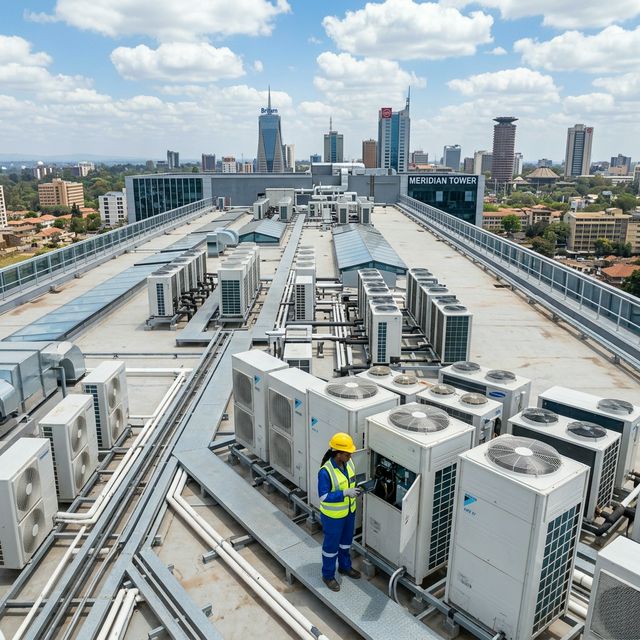
VRF vs Split AC: Making the Right Choice for Your Business
When it comes to air conditioning commercial buildings in Kenya — whether offices, hotels, hospitals, or retail spaces — the choice between VRF (Variable Refrigerant Flow) and traditional split systems is one of the most important decisions you’ll make. Both have their place, and the right choice depends on your building size, budget, and long-term goals.
What is a VRF/VRV System?
VRF (also called VRV — Variable Refrigerant Volume, a Daikin trademark) is an advanced HVAC technology where a single large outdoor unit connects to multiple indoor units throughout a building. The system uses variable-speed compressors to precisely control the amount of refrigerant flowing to each indoor unit, providing simultaneous heating and cooling in different zones.
Comparing VRF and Split Systems
Energy Efficiency
VRF systems are 30-50% more energy efficient than conventional split systems. Their inverter-driven compressors modulate capacity in real-time, using only the exact amount of energy needed. For a large commercial building in Nairobi running AC 10+ hours daily, this translates to massive electricity savings.
Split systems with inverter technology are also efficient but operate independently — each unit has its own compressor running at its own pace, with no coordination between zones.
Initial Cost
VRF systems have a higher upfront cost — typically 40-60% more than equivalent split system capacity. For a 10-floor office building, a VRF system might cost KES 8-15 million compared to KES 5-9 million for split units.
Split systems are more affordable initially and can be installed incrementally — one room or floor at a time as budget allows.
Space Requirements
VRF systems require only 1-3 outdoor units for an entire building, freeing up valuable rooftop or ground-level space. Indoor units come in wall-mounted, cassette, ducted, and floor-standing configurations.
Split systems require one outdoor unit per indoor unit (or per multi-split group of 2-5 units), which can result in dozens of outdoor units cluttering building facades.
Maintenance
VRF systems have centralized maintenance — fewer outdoor units to service, advanced self-diagnostics, and remote monitoring capabilities.
Split systems require individual attention to each unit, but replacement parts are widely available and repairs are simpler.
When to Choose VRF in Kenya
- Multi-storey office buildings (5+ floors)
- Hotels and hospitality establishments
- Hospitals and healthcare facilities requiring precise temperature control
- Large retail and commercial complexes
- Buildings where outdoor unit space is limited
When to Choose Split AC in Kenya
- Small to medium offices (1-3 floors)
- Residential homes and apartments
- Retail shops and restaurants
- Budget-conscious projects needing phased installation
- Rental properties where the system must be removable
Top VRF Brands Available in Kenya
- Daikin VRV — The original and still the benchmark for VRF technology
- Carrier VRF — Reliable with excellent local support
- Toshiba VRF — Compact outdoor units with quiet operation
- Samsung DVM — Innovative design with wind-free indoor units
- Midea V6 — Excellent value with competitive pricing
Spinel Dynamics Group is a certified installer for all major VRF and split AC brands in Kenya. Our engineers can assess your building and recommend the most cost-effective solution. Request a free site survey today — call +254 714 821 020.